Hedge Laying: What It Does, When to Do It and What to Ask a Contractor
A guest article by a Kent hedge and tree contractor: what cutting and bending the stems does for a hedge gone thin at the base, which species respond and which do not, why the work is done between November and February, the two regional styles, and seven questions to put to a contractor before agreeing the job.
Updated 4 November 2026. A guest article by Sky of Littlebourne Hedges and Tree Services, Littlebourne, Kent, published 4 November 2026; the text is the author's own and this page quotes no HortOS figure.
On this page
Drive down almost any country lane and you will pass hedges cut flat on top and left to get leggy. Every year the base gets thinner and the gaps get wider. Hedge laying is the old fix, and it still works.
This page is a guest article by Sky of Littlebourne Hedges and Tree Services, a hedge and tree contractor in Littlebourne, in the Little Stour valley in Kent. The words from here to the end of his closing paragraph are his own. He explains what laying does for a hedge, which hedges it suits, when in the year the work is done, the regional styles a landowner will hear about, and the questions to put to a contractor before agreeing the job. The article appears on HortOS, a free directory of wholesale plant growers in the United Kingdom, listed by county, to which each grower adds its own availability and trade prices. A laid hedge is often gapped up with new plants, and the site's hedging and bare-root guides say where those come from.
Quick facts
| What laying is | Each stem is cut most of the way through near the base, leaving a hinge of bark and living wood, and bent over to lie along the line of the hedge. The hinge keeps the stem growing and new shoots come up from the base and along the laid stems. |
|---|---|
| What it does | A hedge that has only been trimmed goes bare at the base. A laid hedge is dense low down again: it keeps stock in or out, gives birds and small mammals cover, and needs only light trimming for a long time afterwards. |
| What it suits | Native species that regrow readily from the cut: hawthorn, blackthorn, hazel, field maple and similar; holly can be laid but is less forgiving. Conifers such as leylandii do not respond. |
| When | The dormant season, roughly November to the end of February, when the sap is down and before birds nest. Autumn is the time to have a hedge looked at and booked, because good laying slots fill up before the winter. |
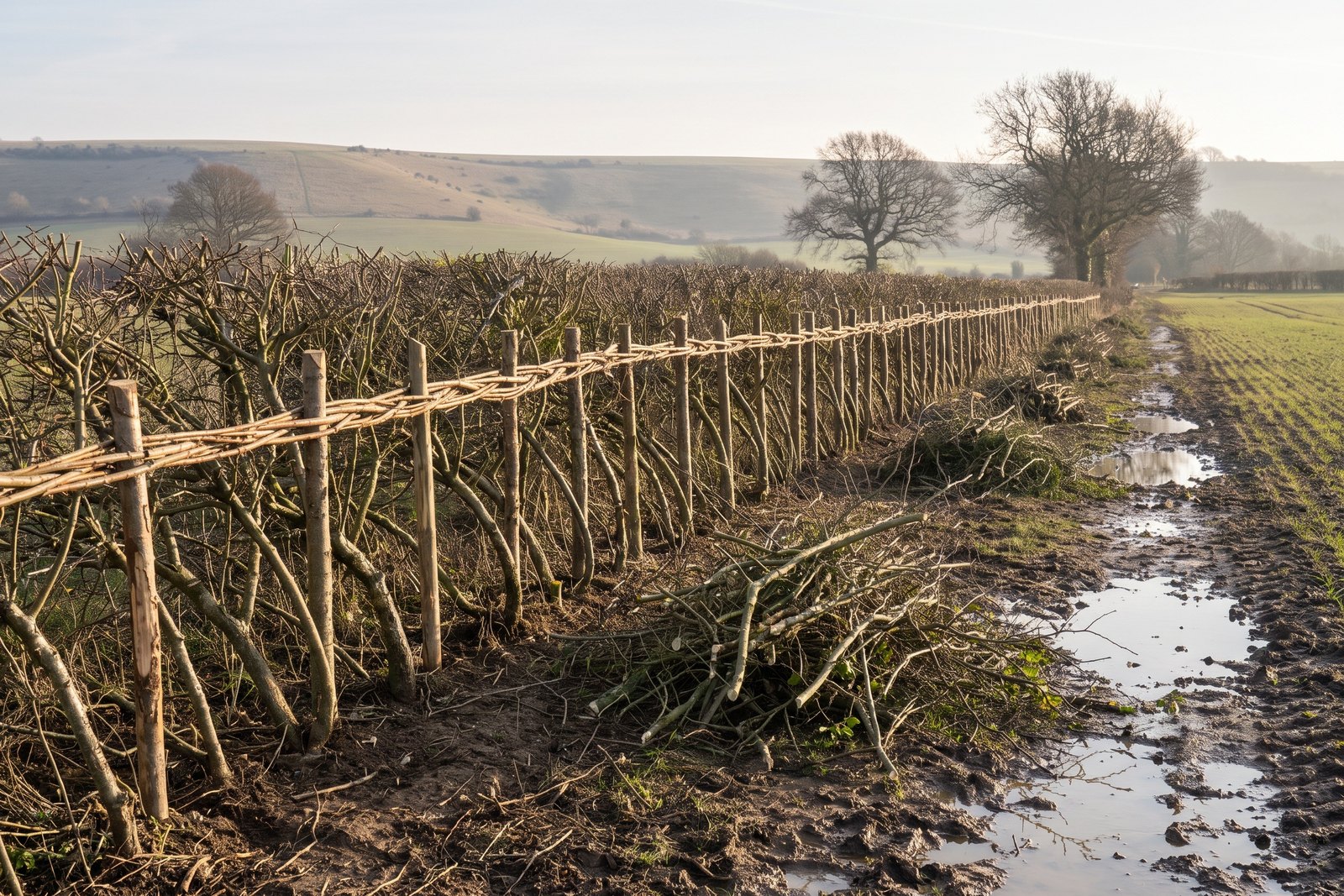
| The styles | Midland style, stems laid at a steep angle and tied in with a woven binding along the top; South of England style, stakes driven in along the line, the laid stems woven between them and a binder along the top. The hedge's job decides the style. |
| Afterwards | A freshly laid hedge looks stark. By the following summer there should be fresh growth along the laid stems, and within a few years the hedge is thick and full again. Fresh laid growth needs protection from grazing animals. |
What laying actually does
Laying means cutting most of the way through each stem near the base, leaving a hinge of bark and living wood, then bending the stem over so it lies along the line of the hedge. Because the hinge stays attached, the stem keeps growing. New shoots then come up from the base and from along the laid stems, and that is what thickens the hedge from the bottom up.
Compare that with a hedge that has only been trimmed for years. It tends to go bare at the base, because the light is all at the top. A laid hedge is dense low down again. It keeps stock in or out, gives birds and small mammals cover, and looks tidy for a long time afterwards, usually with only light trimming.
It also saves a hedge that is past routine cutting. If you have an old hawthorn or hazel line that has grown into a row of tall, spindly trees, laying is often the way to bring it back without starting again.
What to watch for
What it works on
Laying suits native species that regrow readily from the cut: hawthorn, blackthorn, hazel, field maple and similar; holly and some other species can be laid, but they are less forgiving. Conifers such as leylandii do not respond, so if that is what you have, you need a different plan. A good contractor will look at the species and the condition of the stems before quoting, and should tell you honestly if laying is not the right job.
When in the year to do it
Lay in the dormant season, roughly November to the end of February. The sap is down, the stems bend better and the hedge recovers properly in spring. Leaving it later is a mistake for another reason too: birds start nesting in early spring, and it is an offence to intentionally damage an active nest. Be wary of anyone offering to lay a hedge in summer.
If you have a hedge in mind, autumn is the time to get it looked at and booked, because good laying slots fill up before the winter.
Regional styles
There is no single way to lay a hedge. Styles grew up in different parts of the country to suit local stock, local timber and local needs. Two you will hear about:
- Midland style: stems are laid at a steep angle and tied in with a woven binding along the top. It is a tight, stock-proof finish.
- South of England style: typically stakes are driven in along the line, the laid stems are woven between them, and a binder runs along the top to hold everything together. It is a close relative of the Midland style.
Different styles suit different jobs. A hedge beside a field with livestock needs something stronger and tighter than a garden boundary that needs to look neat. A good contractor will ask what the hedge is for before choosing a style, and will tell you what they intend to do.
Getting it right
What a landowner should ask a contractor
Hedge laying is skilled work, and the difference between a well laid hedge and a bad one shows up a year or two later, when the bad one dies back. Before you agree anything, ask:
- What style will you use, and why? The answer should relate to your hedge and what you need from it.
- Which species is it, and will it lay? If they have not looked at the stems, they cannot know.
- When will you do the work? The answer should be in the dormant season, with a plan for any nesting concerns.
- What happens to the cuttings? Laying produces a lot of brash. Ask whether it is cleared, chipped or left, and whether that is in the price.
- How will you protect the hedge afterwards? Fresh laid growth needs protection from grazing animals, and gaps may need replanting.
- Can I see similar work? Photos or a local hedge they have laid will tell you more than a sales pitch.
- Is the price fixed, or per metre? Be clear what is included before work starts.
Also check who can authorise the work. A boundary hedge may be shared with a neighbour, and some are covered by planning conditions or grant agreements.
A word of caution
What to expect afterwards
A freshly laid hedge looks stark, and that can be a shock if you have not seen one before. Give it a season. By the following summer there should be fresh growth coming up along the laid stems, and within a few years the hedge is thick and full again.
If you are thinking about laying a hedge, or you are not sure whether yours is a candidate, get it looked at before the season gets busy. We are a hedge and tree contractor based in Littlebourne. Find out more at littlebournehedges.co.uk.
About the author
Sky runs Littlebourne Hedges and Tree Services, a hedge cutting, hedge reduction and tree work contractor for Littlebourne and the Little Stour valley villages in east Kent. The article above is his, published here as a guest piece. His own page, hedge laying in Littlebourne: the decision route, takes a landowner through the five questions he asks before a job is booked. They cover whether the hedge is a native hedgerow or a garden boundary, whether the stems have the character for laying, the season, and whether a Countryside Stewardship grant applies.
Where the hedging plants come from
The fifth of the questions above says gaps may need replanting. The Royal Horticultural Society's renovation advice puts laying in winter and says the pleachers cut out of a hedge can fill the gap at the end of a laid run. A longer gap is planted in the same dormant season. In England the Countryside Stewardship gapping-up item asks for two year old native transplants of 450 to 600 millimetres, planted in two rows while the hedge is dormant, usually between 1 November and 31 March. No single species makes up more than 70 per cent of the total. Hedging plants for UK gardens sets out the hedging plants British growers list, the forms and grades and how many a metre. Bare-root season in the UK explains the height and transplant codes on a bare-root list and how the plants are handled between the field and the ground.
The growers directory on HortOS lists more than 2,900 growers that sell plants to the trade across the United Kingdom, by county and town, and each grower controls its own listing, prices and delivery. The county pages (Kent, East Sussex, West Sussex, Surrey) show the nurseries near a site. Growers are being added now, and lists and trade prices appear as each grower sends its own. Anyone can read the pages and only the trade can order. A grant funded laying job in England follows the Countryside Stewardship rules for its item, which put the work in the dormant season, usually between 30 September and 31 March, and keep it clear of breeding birds.
Sources
- Littlebourne Hedges and Tree Services: the author's firm in Littlebourne, Kent.
- Littlebourne Hedges and Tree Services, hedge laying in Littlebourne: the decision route: the author's own page on whether to lay.
- Royal Horticultural Society, hedges: renovation techniques: laying in winter, pleachers, stakes and binders.
- National Hedgelaying Society, hedgelaying styles: the Midland and South of England styles.
- Wildlife and Countryside Act 1981, section 1: the protection of wild birds and their nests.
- GOV.UK, Countryside Stewardship capital item BN5, hedgerow laying: the laying grant and its dormant season rule.
- GOV.UK, Countryside Stewardship capital item BN7, hedgerow gapping-up: the plants and season for gapping up.
- Hedgelink: the UK hedgerow partnership's guidance.
More guides
Hedging Plants for UK Gardens, and Who Grows Them
The same hedge can cost five times as much in pots in May as bare-root in December. This page sets out the hedging plants British growers list for native, formal, evergreen, screening and coastal hedges, the forms and grades they come in, how many a metre and when to plant, what has replaced box and the law on cutting.
Bare-Root Season in the UK: What Growers List and When
From November to March British nurseries lift deciduous trees, hedging, roses and fruit from open ground and sell them bare-root at a fraction of the container price. This page explains what is sold this way, the height, girth and transplant codes on a list, how the season runs and how the plants are handled.

Native and Pollinator Plants for Community Plantings in the UK
A pollinator planting is judged by the insects it feeds. This page explains what a community planting needs, how the Royal Horticultural Society's Plants for Pollinators lists are used, the place of native plants and of British origin, a palette that flowers from February to November in the forms British growers list, and how the planting is kept afterwards.