Native and Pollinator Plants for Community Plantings in the UK
A pollinator planting is judged by the insects it feeds. This page explains what a community planting needs, how the Royal Horticultural Society's Plants for Pollinators lists are used, the place of native plants and of British origin, a palette that flowers from February to November in the forms British growers list, and how the planting is kept afterwards.
Updated 28 October 2026. Grower totals from the live uk.hortosapp.com county pages on 28 October 2026; this page quotes no HortOS price figure, because growers are still adding their lists.
On this page
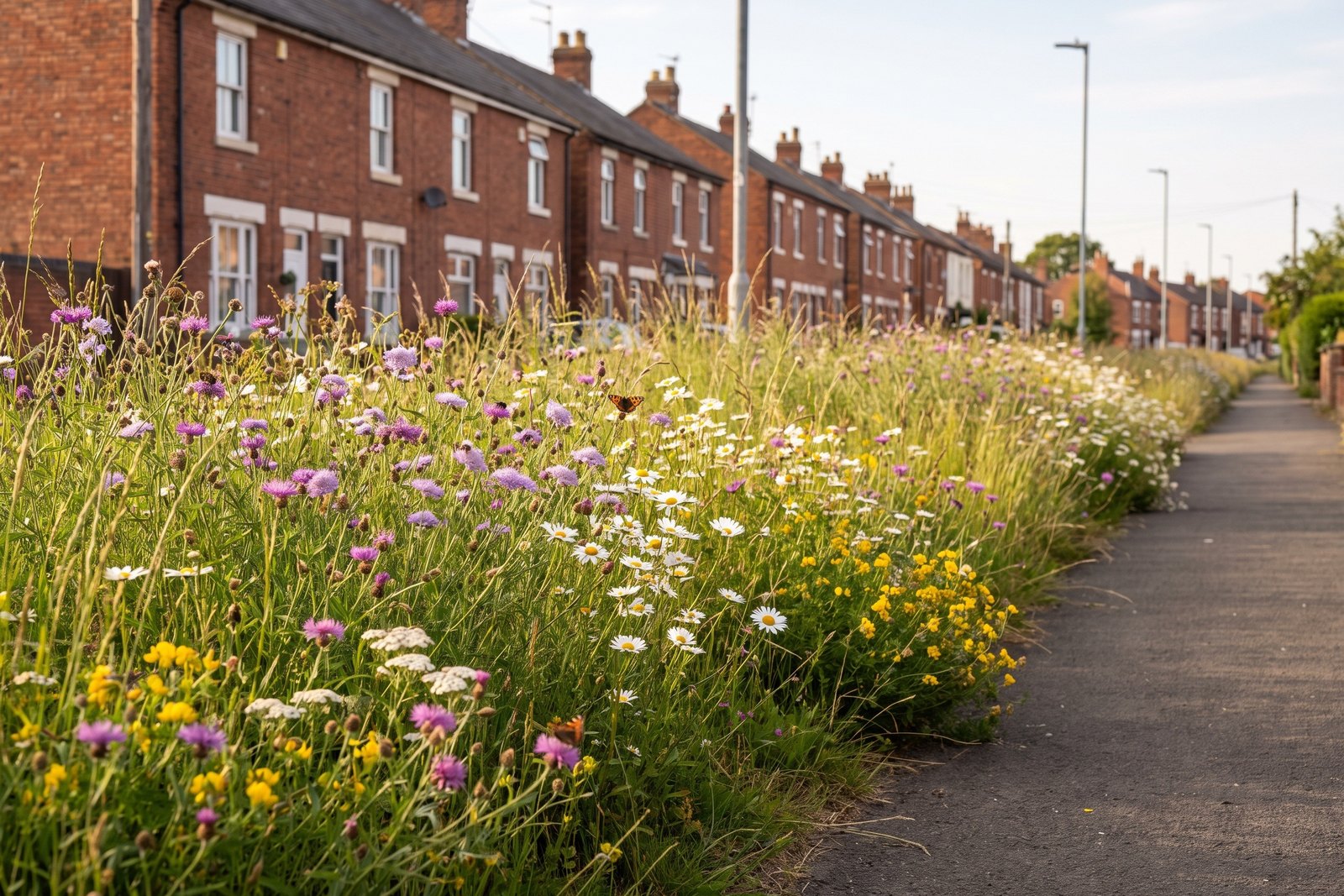
A pollinator planting is judged by the insects, not the committee. A bed of double flowered bedding in July feeds nothing; a verge of knapweed, scabious and birdsfoot trefoil feeds everything that flies. The difference is not money, because the second costs less, but knowledge: which plants carry nectar and pollen an insect can reach, how to run flowering from February to November, where the plants come from, and how the bed is kept afterwards. Community groups across Britain now plant for pollinators by the thousand, and the nurseries that grow the plants have followed.
This page explains what a pollinator planting needs, how the Royal Horticultural Society's Plants for Pollinators lists are used, the place of native plants and of provenance, what British growers list in which forms, a palette through the seasons, and how the planting is managed. It draws on HortOS, a free directory of wholesale plant growers in the United Kingdom, listed by county, to which each grower adds its own availability and trade prices, and on what the Society, Plantlife, the Bumblebee Conservation Trust and Kew publish. It quotes no HortOS price figure, because growers are still adding their lists to the UK site.
Quick facts
| What insects need | Open, single flowers with reachable nectar and pollen, in drifts large enough to find, from the first crocus to the last ivy flower, with no insecticide on the plants or the bed, and somewhere to nest and drink. |
|---|---|
| The lists | The Royal Horticultural Society's Plants for Pollinators lists, relaunched in July 2025 after a review begun in 2022, name over ten thousand plants under three headings: garden plants, wild plants and plants from the wider world. |
| Native or not | The Society's evidence is that a mixture serves best: native plants for the specialists and the larval food plants, with near native and garden plants to fill the gaps in the season. |
| Provenance | For a meadow or a wild planting, ask for seed and plugs of British native origin, from a named region where the supplier can give one. |
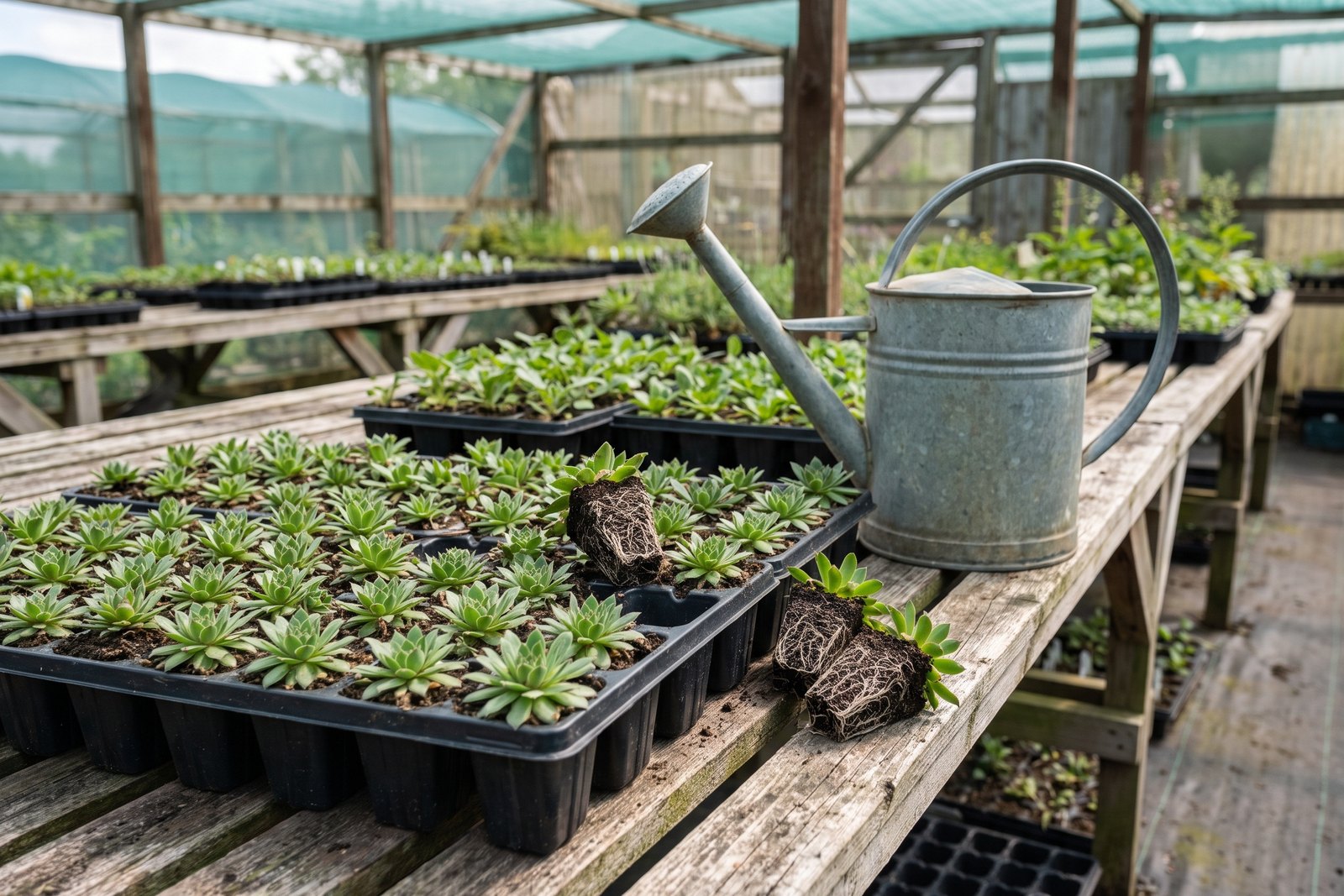
| The forms | Plugs for meadows and verges, nine centimetre and two litre pots for borders, bare-root for native shrubs and trees, and seed for the biggest areas. |
| Management | A late summer cut and lift for a meadow; a spring, not autumn, tidy for a border; no spraying; a water source; bare ground and dead stems left for nesting. |
What a pollinator planting needs
Four things decide whether a planting works for insects. The first is the flower itself: single, open flowers whose nectar and pollen a bee, hoverfly, butterfly or moth can reach, which rules out most doubles and many of the highly bred bedding plants. The second is the season: bumblebee queens fly in February and March, solitary bees in spring, hoverflies and butterflies through the summer, and the last bumblebees and the ivy bee into October and November, so a planting needs something in flower in every month from late winter to late autumn. The third is quantity: insects find a drift of one plant more easily than a scatter of twenty, so plant in groups of five, seven and more. The fourth is what else is done: a bed treated with insecticide is a trap, and a planting with no bare soil, no hollow stems and no water nearby feeds insects that cannot live there.
The Royal Horticultural Society puts the pesticide point first in its own advice: avoid using any pesticide in the outdoor space, and where a buyer wants to be sure the plants themselves carry no residue, the Society keeps a list of organic nurseries. A community group can ask any nursery what the plants were treated with and when; a grower that has moved to biological control will say so.
Using the Plants for Pollinators lists
The Society's Plants for Pollinators lists are the standard reference in Britain. They were rebuilt between 2022 and 2025 from research, the Society's own trials and the records of gardeners and beekeepers, relaunched in July 2025, and now name more than ten thousand plants in three downloadable documents: cultivated garden plants, wild plants native to Britain, and plants from elsewhere in the world. Some plants were removed in the review and many groups added. Nurseries may use the Society's logo on plants from the lists under licence, and a buyer specifying a planting can simply require that every plant be on one of them.
The lists do not say which plant to use where. That is the group's job, with help from the local wildlife trust, the county recorder or the Bumblebee Conservation Trust's advice, which sets out what each kind of bumblebee needs and when. A sunny, dry bank, a damp ditch side and a shaded churchyard wall want three different palettes, all drawn from the same lists.
Native plants, and where they come from
Native plants matter most for the insects that depend on them: the caterpillars of most British butterflies and moths eat particular native plants and nothing else, and many solitary bees collect pollen from a narrow range. For a nectar and pollen planting the Society's evidence favours a mixture, native plants at the core with near native and garden plants to carry the season through. For a meadow, a verge, a hedge or a wild corner, native plants of British origin are the whole point.
Origin is the word to use with a supplier. A plant can be a native species and have been grown from seed collected in Hungary; it will flower at a different time and may cross with the local population. Plantlife and the Society both advise seed and plugs of British native origin for wild plantings, from a named region where the supplier can give one, and Kew's Native Seed Hub was set up to supply and encourage seed of known origin for exactly this use. The specialist wildflower nurseries state origin on their lists; a general nursery will ask its supplier if a buyer asks it. Plant passports and plant health rules for plant buyers explains the label that records where a plant was grown.
A palette through the seasons
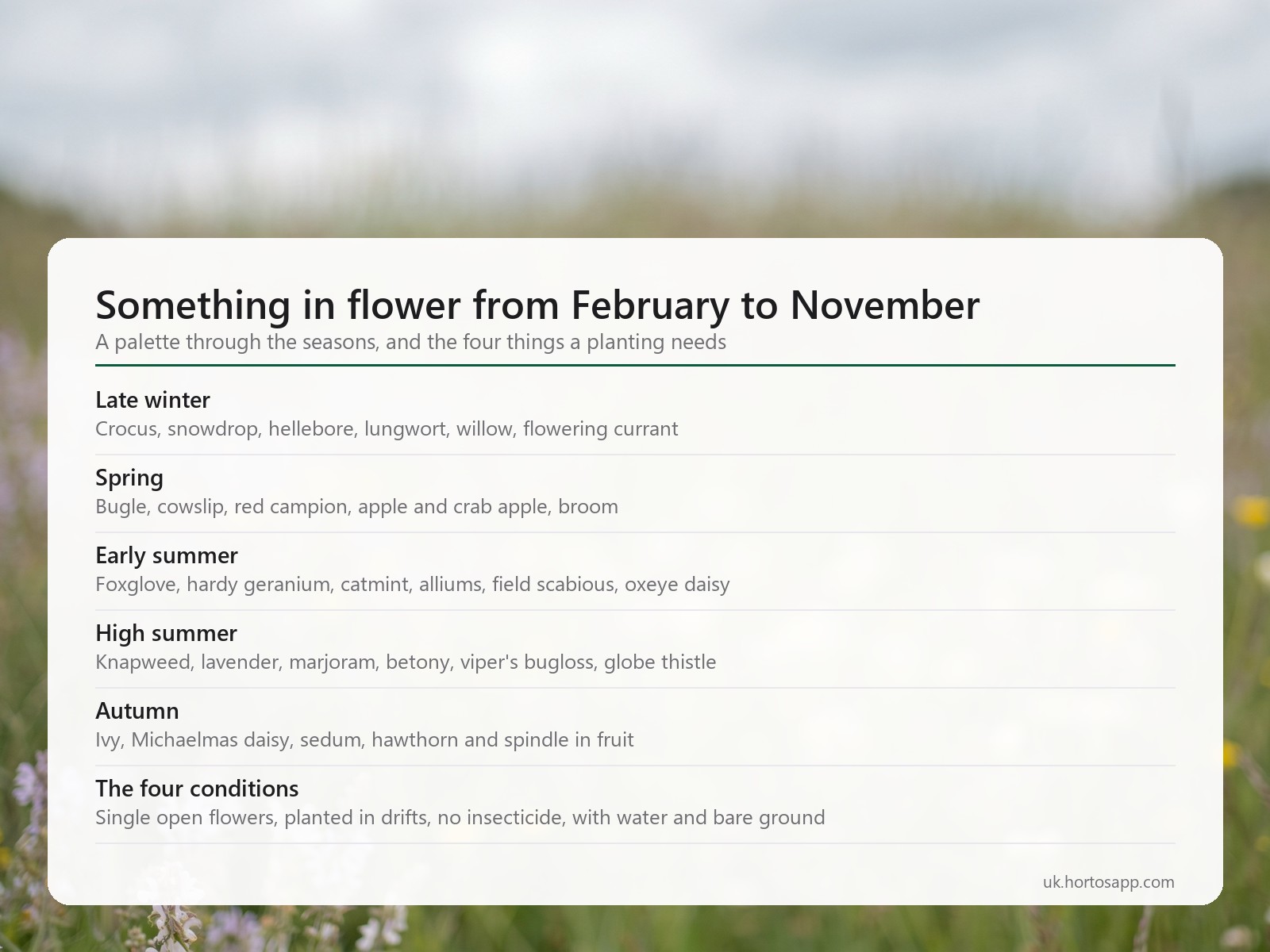
The plants below are on the Society's lists, are grown by British nurseries in the forms shown, and between them flower from February to November. A group picks from each season for its soil and aspect rather than planting the whole table.
| Season | Plants growers list | Form | Notes |
|---|---|---|---|
| Late winter to early spring | Crocus, snowdrop, hellebore, lungwort, willow, flowering currant, hawthorn | Bulbs in autumn; 9 cm and 2 litre pots; bare-root shrubs | Queen bumblebees and the first solitary bees |
| Late spring | Bugle, cowslip, red campion, apple and crab apple, broom, honesty, forget-me-not | Plugs and 9 cm pots; bare-root trees | Butterflies emerge; orchard blossom carries a month |
| Early summer | Foxglove, hardy geranium, catmint, chives and other alliums, field scabious, oxeye daisy, thyme | 9 cm and 2 litre pots; plugs for meadows | The peak for solitary bees and hoverflies |
| High summer | Knapweed, lavender, marjoram, betony, viper's bugloss, globe thistle, bramble | 2 litre pots; plugs; bare-root bramble and rose | Long tongued bumblebees on the tubular flowers |
| Late summer | Devil's bit scabious, sedum, hemp agrimony, teasel, heather, sunflower | 2 and 3 litre pots; plugs | Butterflies feeding before the autumn |
| Autumn | Ivy, Michaelmas daisy, verbena, late sedums, hawthorn and spindle in fruit | Container; ivy already present | The ivy bee and the last bumblebee workers |
A verge or meadow is planted from plugs at nine to twelve a square metre into bare ground, or sown, and a border from nine centimetre and two litre pots at five to nine a square metre. Buying plants in bulk for a community group in the UK turns those densities into an order, and Hedging plants for UK gardens covers the native hedge that is the best pollinator planting of all.
Keeping the planting
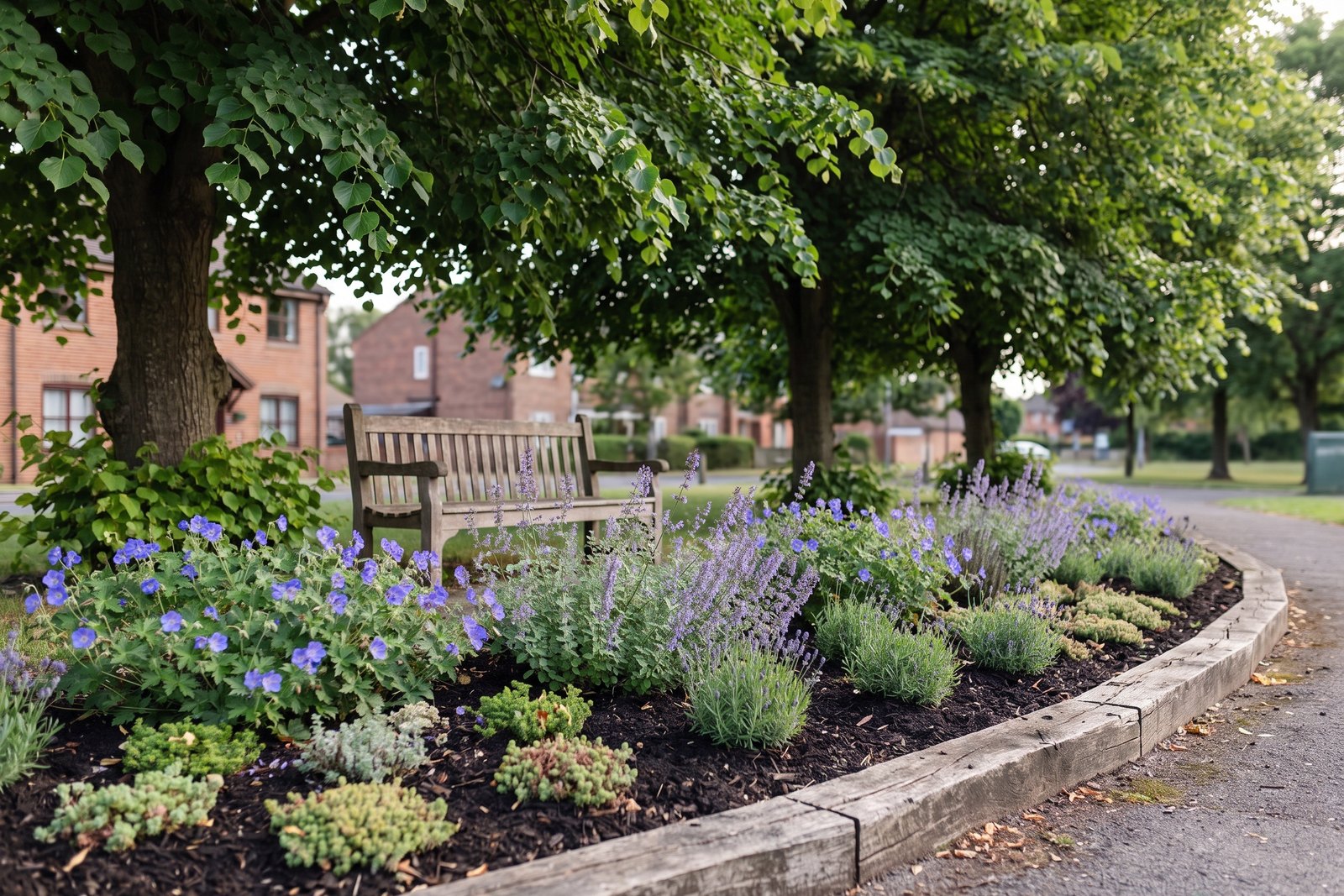
A pollinator planting is kept differently from a tidy one. A meadow or a verge is cut once in late summer, after the seed has set, and the cuttings are raked off and taken away, which is the single practice that turns a grass verge into a flowering one over three or four years. A border is left standing through the winter for the seed heads and the hollow stems that insects overwinter in, and tidied in March rather than October. No insecticide is used on the bed or the plants, and slug pellets go too. A patch of bare, sunny ground is left for mining bees, a shallow dish of water with stones in it is kept filled in summer, and a log or a bundle of cut stems is left in a corner.
Groups that record what they see, through the national pollinator monitoring scheme's simple flower counts or a photograph a month, learn which plants in their own bed do the work and order more of those the next year.
Where the growers are
The growers directory on HortOS lists more than 2,900 growers that sell plants to the trade across the United Kingdom, by county and town, and each grower controls its own listing, prices and delivery. The county pages (Lancashire, Lincolnshire, Cambridgeshire, Staffordshire) show the nurseries near a site. Growers are being added now, and lists and trade prices appear as each grower sends its own. Anyone can read the pages and only the trade can order. The wildflower and native plant nurseries are few and sell nationally; the perennials and shrubs on the Society's lists are grown by hundreds of nurseries, and the county pages show the nearest. On 28 October 2026 the county pages listed 199 in Lancashire, 153 in Lincolnshire, 149 in Cambridgeshire, 144 in Staffordshire, 136 in Norfolk and 133 in Cheshire.
What to watch for
- Double flowers and heavily bred bedding. They look like flowers to a committee and not to a bee; check the Society's lists.
- A native species of foreign origin in a wild planting. Ask for British native origin and a region, and expect the specialist nurseries to give one.
- Plants treated with a systemic insecticide before sale. Ask what the plants were treated with and when, or buy from the Society's organic list.
- A gap in May or in September. Lay the palette out by month before ordering and fill the empty ones.
- An autumn tidy. Cutting a pollinator border down in October removes the winter homes of the insects it fed.
- Grass cuttings left on a meadow. They feed the grass; rake them off every time.
Getting it right
- Walk the site and note sun, shade, wet and dry; choose a palette for each part from the Society's lists.
- Lay the palette out by month from February to November and fill the gaps before ordering.
- For wild plantings, specify British native origin and ask for the region; for borders, group plants in fives and sevens.
- Ask every nursery what the plants were treated with, and buy from those that answer.
- Plant plugs into bare ground in autumn or spring, pots in autumn, and water through the first summer.
- Cut meadows once in late summer and lift the cuttings; tidy borders in March; spray nothing; keep water and bare ground.
A word of caution
The plants, seasons and densities on this page are general and drawn from the sources named; the Royal Horticultural Society's lists and the Bumblebee Conservation Trust's and Plantlife's advice are the authorities, and a local wildlife trust or county recorder knows the site better than any national list. Statements about which insects use which plants are the researchers' and the Society's. Where a planting is on land a group does not own, the owner's consent and any management agreement come first, and a verge beside a road is the highway authority's to agree. HortOS lists growers; it does not certify origin or treatment, and a buyer that needs either asks the grower in writing.
Sources
- Royal Horticultural Society, Plants for Pollinators: the evidence based plant lists.
- Plantlife: wild plants, meadows and provenance.
- Bumblebee Conservation Trust: what bumblebees need through the year.
- Royal Botanic Gardens, Kew, UK Native Seed Hub: native seed of known origin.
- The Conservation Volunteers: community planting and tree nurseries.
More guides
Plant Passports and Plant Health Rules for Plant Buyers in the UK
Every consignment of plants that moves between businesses in Great Britain carries a UK plant passport, and a buyer sits at the end of that chain. This page explains what the passport is and who issues it, what a buyer should expect and keep, how imported plants are checked, the rules on oak, the Northern Ireland position and Plant Healthy.
Buying Plants in Bulk for a Community Group in the UK
Garden societies, allotment associations, schools and In Bloom groups can buy plants by the tray, trolley and bundle from British wholesale nurseries when they order like the trade. This page explains what bulk means to a nursery, the three ways a group buys, how a plan becomes quantities, how VAT falls and what happens on delivery day.
Hedging Plants for UK Gardens, and Who Grows Them
The same hedge can cost five times as much in pots in May as bare-root in December. This page sets out the hedging plants British growers list for native, formal, evergreen, screening and coastal hedges, the forms and grades they come in, how many a metre and when to plant, what has replaced box and the law on cutting.