Plant Passports and Plant Health Rules for Plant Buyers in the UK
Every consignment of plants that moves between businesses in Great Britain carries a UK plant passport, and a buyer sits at the end of that chain. This page explains what the passport is and who issues it, what a buyer should expect and keep, how imported plants are checked, the rules on oak, the Northern Ireland position and Plant Healthy.
Updated 26 October 2026. Grower totals from the live uk.hortosapp.com county pages on 26 October 2026; this page quotes no HortOS price figure, because growers are still adding their lists.
On this page
Every tray of plants that leaves a British nursery for another business carries a small label that most buyers never read. It is a UK plant passport, and it is the thread by which an outbreak of a pest or disease is traced back to the batch it came from. Since the end of 2020 Great Britain has run its own plant health regime, Northern Ireland has kept the European Union's, and plants imported from the Continent have faced checks at the border. A council, a landscaper or a community group that buys plants is at the end of that chain, and a little knowledge of it saves a great deal of trouble.
This page explains what a UK plant passport is and who must issue one, what a buyer should expect and keep, how imported plants reach a British trade list, the movement rules that bite on particular plants such as oak, the position in Northern Ireland, and the certification a careful buyer looks for. It draws on HortOS, a free directory of wholesale plant growers in the United Kingdom, listed by county, to which each grower adds its own availability and trade prices, and on what the government's plant health pages and the trade's certification scheme publish. It is a summary for buyers, not legal advice, and the official pages are the ones to rely on.
Quick facts
| What it is | A UK plant passport is a label, issued by a professional operator authorised by the Animal and Plant Health Agency or the Forestry Commission, that must travel with regulated plants moved within Great Britain, to the Isle of Man and to the Channel Islands. |
|---|---|
| What needs one | All plants for planting, from a plug to a semi-mature tree, plus certain seeds, seed potatoes at every stage, and some wood. The government publishes the list. |
| When it is not needed | For a sale to a final user buying for personal use in person. A sale to a final user by distance, online for example, still needs one; so does any supply to another business. |
| Imports | Plants from the European Union move under the Border Target Operating Model: a phytosanitary certificate from the exporter, a notification before arrival, and checks at a border control post for the higher risk categories. |
| Northern Ireland | Northern Ireland applies the European Union's plant health rules. Plants from Great Britain move under the Northern Ireland Plant Health Label scheme or with a phytosanitary certificate, and must stay in Northern Ireland. |
| Certification | Plant Healthy certification, audited each year against the Plant Health Management Standard, marks a nursery or landscaper that manages biosecurity to a published standard. |
What a UK plant passport is
A plant passport is a label attached to a plant, a tray, a bundle or a consignment that identifies what the plant is, which country it was grown in, which registered operator is responsible for it and a traceability code for the batch. In Great Britain, which is England, Scotland and Wales, the label is the UK plant passport, issued since 1 January 2021 in place of the European Union's. Only a professional operator that has registered and been authorised by the Animal and Plant Health Agency, or by the Forestry Commission for forestry material, may issue one, and the operator must examine the plants and keep records before it does.
The government's list of what needs a passport is short to read and wide in effect: all plants for planting, which means every live plant intended to stay alive and grow, from a seedling in a cell tray to a rootballed tree, together with certain seeds, seed potatoes at every stage of the trade chain, and some wood and bark. A nursery that sells to another nursery, a garden centre, a landscaper or a council must issue a passport for every such plant it despatches. The same applies to a retailer supplying another business, and there is no exemption for supplying a retailer.
What a buyer should expect and keep
The duty to issue sits with the operator that moves the plants, not with the buyer, but a buyer sits at a particular point in the chain and should know which. A person buying a plant for their own garden, in person, needs no passport and will not see one. A business or organisation that buys plants to plant them, a council planting a park, a contractor planting a client's scheme, a school or society planting its own ground, is the final user of those plants and issues nothing, but the plants should arrive with their passports because they moved between operators to get there. A business that buys plants and sells or passes them on to another business is in the chain and needs its own authorisation; a group that is unsure of its position asks the Animal and Plant Health Agency.
The sensible habit is to keep the passport labels with the delivery note for each planting. If a notifiable pest or disease is found later, the plant health inspector's first question is where the plants came from, and the label answers it in a minute. For a planting that is funded or audited, the labels also show the funder that the plants were legally moved.
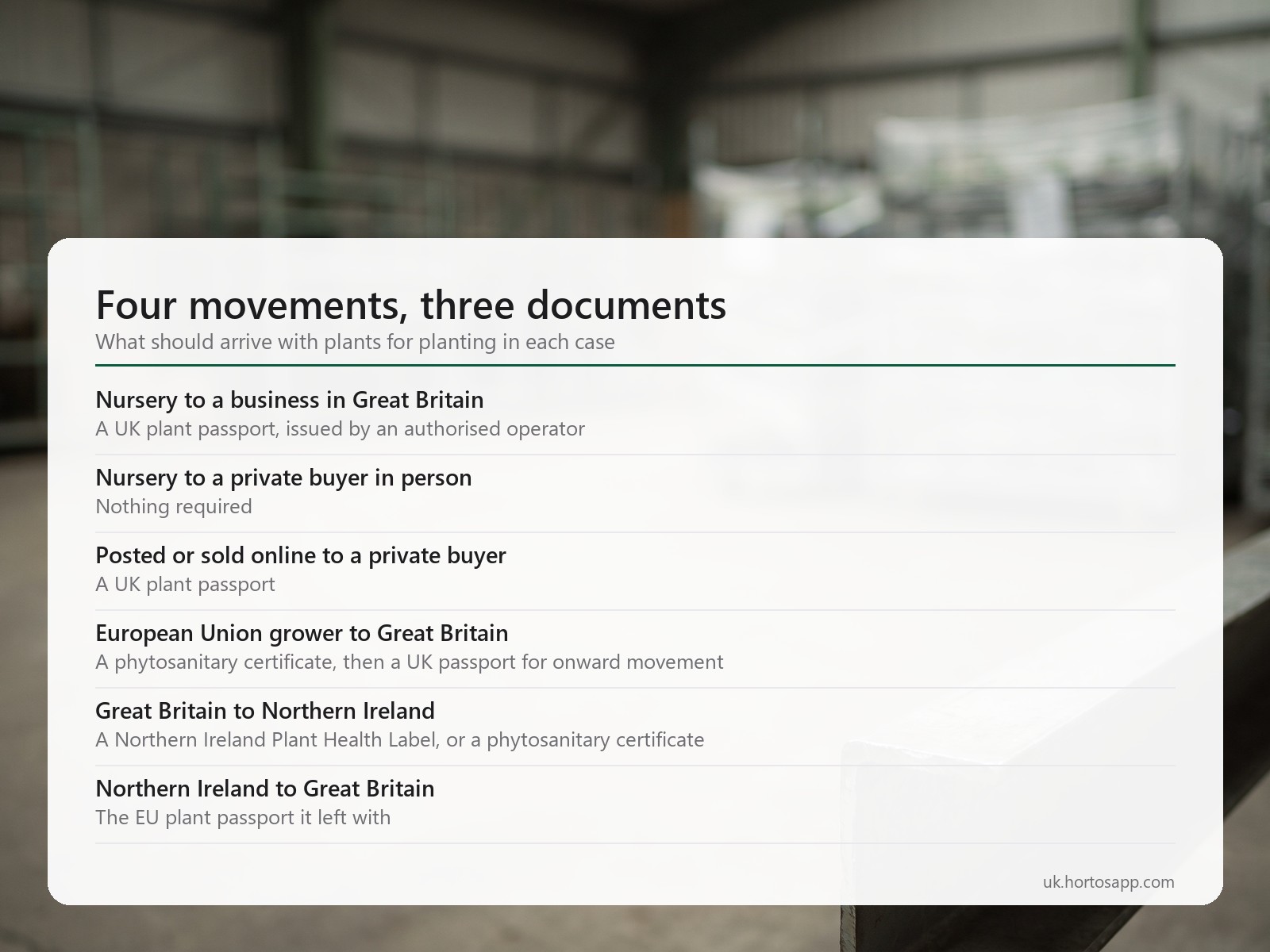
| The movement | What travels with the plants | Who is responsible |
|---|---|---|
| Nursery to another business in Great Britain | A UK plant passport | The despatching nursery, as an authorised operator |
| Nursery to a private buyer in person | Nothing required | No passport is needed for a retail sale paid in person |
| Nursery to a private buyer by post or online | A UK plant passport | The seller, which must be authorised and may join the distance sellers list |
| European Union grower to Great Britain | A phytosanitary certificate, then a UK passport for onward movement | The importer, through the pre-notification system and border checks |
| Great Britain to Northern Ireland | A Northern Ireland Plant Health Label or a phytosanitary certificate | A Great Britain operator authorised under the label scheme |
| Northern Ireland to Great Britain | The European Union plant passport it left with | Qualifying Northern Ireland goods move as they did before 2021 |
How imported plants reach a British list
Imports of ornamentals are worth as much as home production, and a plant on a British trade list may have been grown on from a Dutch, Belgian or Italian young plant. Since 2024 plants and plant products from the European Union have entered Great Britain under the Border Target Operating Model, which sorts them into risk categories. High risk and medium risk goods need a phytosanitary certificate from the exporting country's plant health service, a notification on the government's import system before arrival, and, for the higher categories, an inspection at a border control post. Once in Great Britain the importer attaches a UK plant passport before the plants move on. A nursery that buys in young plants carries these costs and delays, and they are part of why lead times for some lines lengthened after 2024.
A buyer does not see any of this paperwork and does not need to. What a buyer can do is ask where a plant was grown and for how long it has been in Britain, because a plant grown on for a season or two in a British nursery has been under British inspection for that time. Some buyers, councils and conservation bodies among them, specify British grown stock for that reason, and the Woodland Trust runs a scheme that marks trees raised from seed collected and grown in these islands. Bare-root season in the UK explains how provenance is asked for on a bare-root order.
The plants with rules of their own
A few plants carry movement rules on top of the passport, and a buyer specifying them should know. Oak is the clearest case. Oak processionary moth is established in London and parts of the South East, and the government manages it through zones: an established area, a buffer zone and the area free of the pest. Moving large oak trees within the management zones is restricted, oak trees for planting carry conditions on where they may have been grown, and anyone who finds a nest must report it through the Forestry Commission's reporting tool. A council or group planting oaks asks the nursery which zone the trees were grown in before ordering.
Other plants carry import conditions that follow them onto a British list. The hosts of the bacterium Xylella fastidiosa, among them olive, lavender, rosemary and some other Mediterranean shrubs, may enter Great Britain only from places and nurseries that meet strict conditions, and a buyer specifying them in numbers should expect the nursery to know the history of the batch. Seed potatoes need a passport at every stage, which matters to allotment societies that buy them together. The government's plant health pages keep the current lists, and they change; the nursery that sells the plant is the first person to ask.
Northern Ireland
Northern Ireland stayed in the European Union's plant health area under the Windsor Framework, so its nurseries issue EU plant passports and trade freely with the Republic of Ireland and the rest of the Union. Plants moving from Great Britain to Northern Ireland are the complicated case. Since 1 October 2023 a grower or trader in Great Britain that is authorised under the Northern Ireland Plant Health Label scheme can send plants for planting with that label instead of a phytosanitary certificate, provided the plants meet Northern Ireland's requirements, have had the growing season inspections the scheme asks for, and stay in Northern Ireland. Anything bound for the Republic needs the full certificate. Plants moving the other way, from Northern Ireland to Great Britain, travel on their EU passports as they did before 2021. Wholesale plant growers in Northern Ireland sets the position out for buyers on both sides of the water.
The certification a careful buyer looks for
Beyond the legal minimum, the trade has built its own standard. The Plant Healthy certification scheme, governed by the Plant Health Alliance and audited each year, certifies nurseries, landscapers, retailers and gardens that manage biosecurity to the Plant Health Management Standard: how plants are sourced and inspected, how pests are watched for and reported, how water, waste and vehicles are managed, how staff are trained. The scheme publishes a directory of certified businesses. A buyer that wants more than a passport asks whether the nursery holds it, or writes it into a tender as a preference. Several of the larger tree and hedging nurseries have held the certificate for years.
Where the growers are
The growers directory on HortOS lists more than 2,900 growers that sell plants to the trade across the United Kingdom, by county and town, and each grower controls its own listing, prices and delivery. The county pages (Lancashire, Lincolnshire, Cambridgeshire, Staffordshire) show the nurseries near a site. Growers are being added now, and lists and trade prices appear as each grower sends its own. Anyone can read the pages and only the trade can order. A buyer with a question about a plant's history asks the nursery that grew it, and the county pages show which nurseries grow near the site. On 26 October 2026 the county pages listed 199 in Lancashire, 153 in Lincolnshire, 149 in Cambridgeshire, 144 in Staffordshire, 136 in Norfolk and 133 in Cheshire. Buying plants in bulk for a community group in the UK explains how a group writes its order.
What to watch for
- Plants that arrive with no label at all. Ask the nursery why before the lorry leaves; a consignment between businesses should carry passports.
- Labels thrown away with the packaging. Keep them with the delivery note for each planting.
- Oak ordered without asking which zone it was grown in. The nursery knows; a council planting in the South East must.
- Plants bought from a private seller or an online marketplace for a public planting. The passport chain may not exist, and the plants cannot be traced.
- A group that resells plants, at a plant sale for instance, after buying them from the trade. That group may be an operator in the chain; ask the Animal and Plant Health Agency.
- Assuming the rules are the same in Belfast as in Birmingham. They are not; Northern Ireland follows the European Union's.
Getting it right
- Buy plants for planting from a nursery that is an authorised operator, and expect a UK plant passport on each consignment.
- Keep the passport labels with the delivery note, filed by planting, for as long as the planting is yours.
- Ask where a plant was grown and how long it has been in Britain, and specify British grown stock where the project calls for it.
- Check the government's current movement rules for oak and the other listed plants before specifying them.
- For a Northern Ireland site, buy from Northern Ireland or the Republic, or from a Great Britain supplier authorised under the label scheme.
- Prefer, or require, Plant Healthy certification in tenders and larger orders.
A word of caution
Plant health law is detailed and it changes; this page describes the position in general terms as it stood on the date shown and is not legal advice. The Animal and Plant Health Agency in England and Wales, the Scottish Government's plant health service in Scotland, the Forestry Commission for forestry material and the Department of Agriculture, Environment and Rural Affairs in Northern Ireland are the authorities, and their pages and inspectors have the last word on any consignment. HortOS lists growers; it does not inspect them, certify them or hold their plant health records.
Sources
- GOV.UK, issue plant passports to move regulated plant material in Great Britain: who issues a UK plant passport.
- GOV.UK, plants and wood that need a plant passport for movement within Great Britain: the list that includes all plants for planting.
- GOV.UK, import plants and plant products from the EU to Great Britain: the border checks on imports.
- GOV.UK, managing oak processionary moth in England: the zones and the oak movement rules.
- Department of Agriculture, Environment and Rural Affairs, NI Plant Health Label scheme: moving plants to Northern Ireland.
- Plant Healthy certification scheme: the trade's biosecurity certification.
- Animal and Plant Health Agency: the authority in England and Wales.
More guides
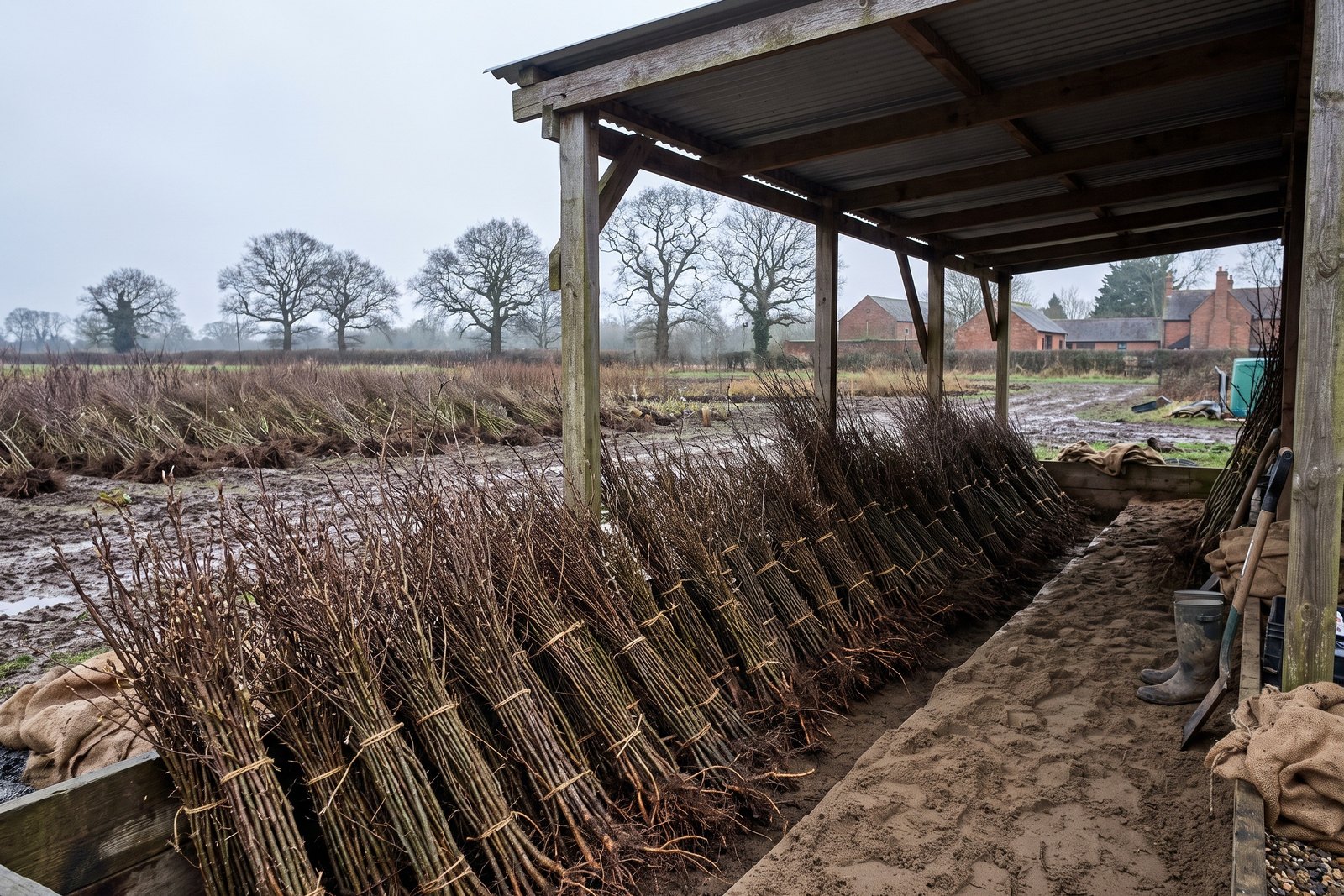
Bare-Root Season in the UK: What Growers List and When
From November to March British nurseries lift deciduous trees, hedging, roses and fruit from open ground and sell them bare-root at a fraction of the container price. This page explains what is sold this way, the height, girth and transplant codes on a list, how the season runs and how the plants are handled.
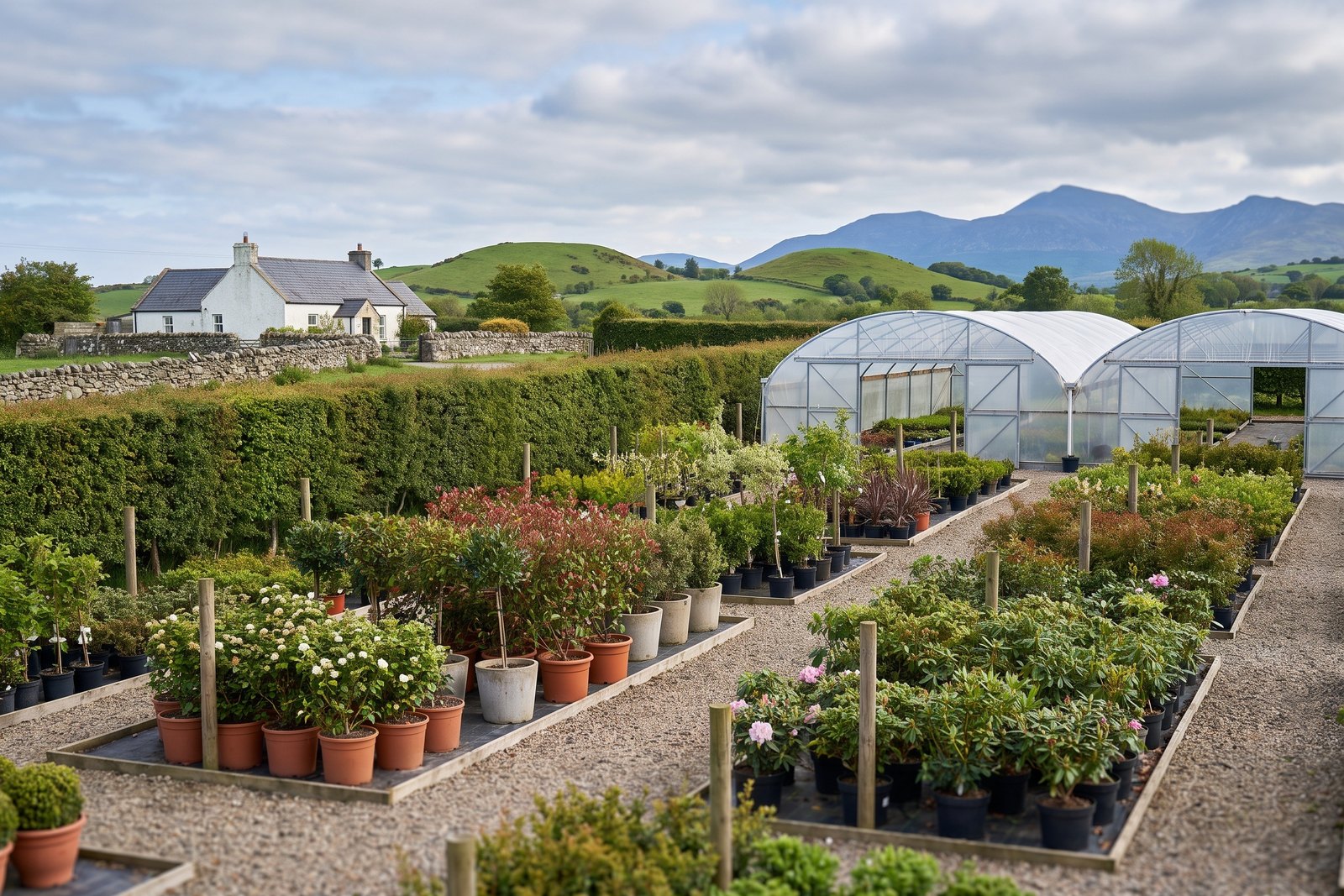
Wholesale Plant Growers in Northern Ireland and the Plant Health Rules
In Northern Ireland a plant from Lancashire is an import and a plant from County Louth is not. This page sets out what the HortOS directory lists in the six counties, the plant health position under the Windsor Framework, the label scheme for plants from Great Britain, and what it means for buyers in the province and in the Republic.
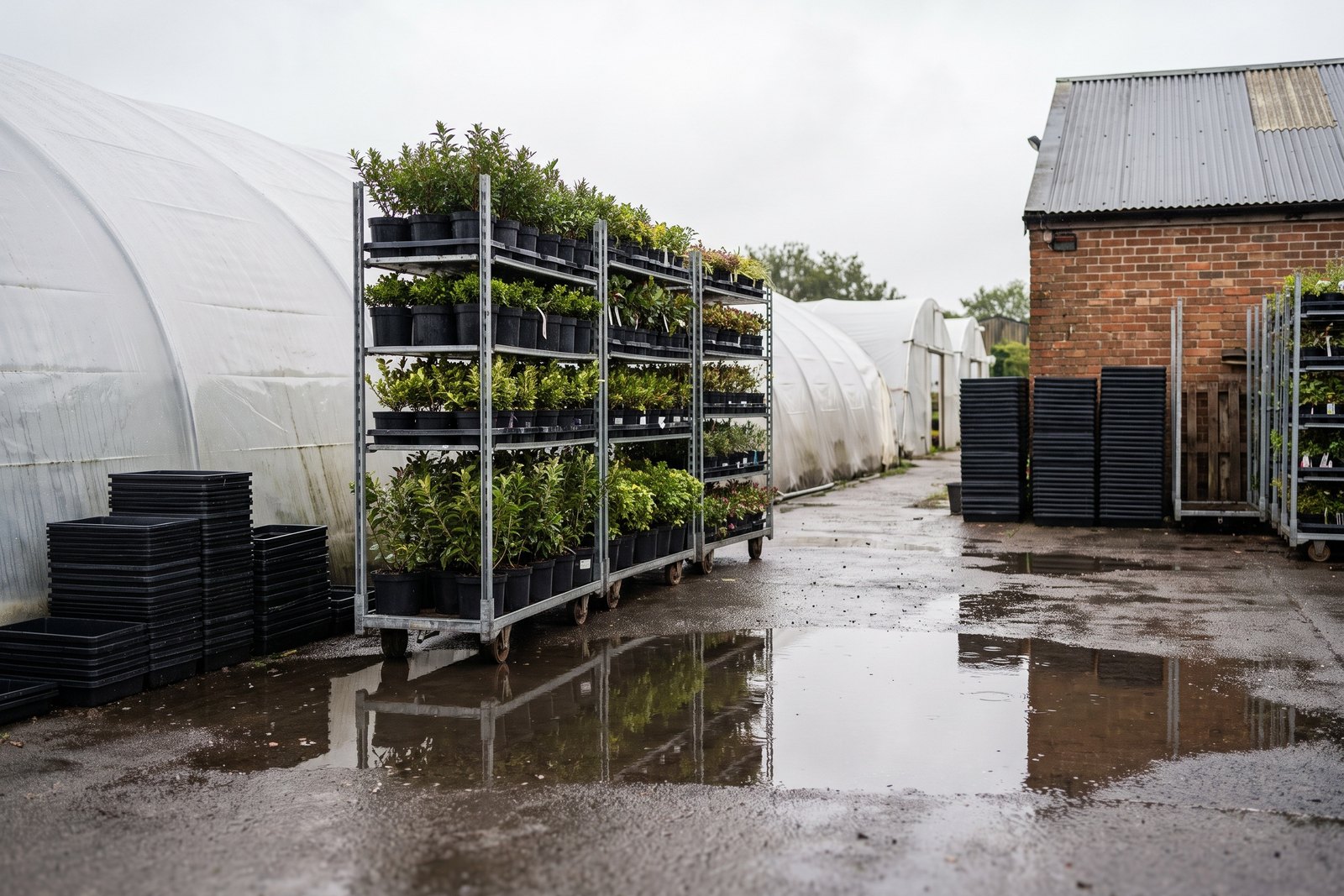
Buying Plants in Bulk for a Community Group in the UK
Garden societies, allotment associations, schools and In Bloom groups can buy plants by the tray, trolley and bundle from British wholesale nurseries when they order like the trade. This page explains what bulk means to a nursery, the three ways a group buys, how a plan becomes quantities, how VAT falls and what happens on delivery day.