Peat-Free Growing: What UK Nurseries Supply Now
No ban on peat was in force in the UK when this page was written, and the trade has moved on its own. This page explains where the law stands, what the Royal Horticultural Society and the nurseries have done, what the peat-free growing media are and how plants grown in them behave, and what a buyer asks a grower.
Updated 25 October 2026. Grower totals from the live uk.hortosapp.com county pages on 25 October 2026; this page quotes no HortOS price figure, because growers are still adding their lists.
On this page
Ask a British nursery whether its plants are peat-free and the honest answer is usually a sentence, not a word. The shrub in the three litre pot was potted into bark and wood fibre two years ago. The plug it grew from was struck in the Netherlands in a peat mix the year before. The bedding was sown in a peat-reduced medium that still had a third of peat in it. A buyer who wants peat-free plants has to know which question to ask, and a nursery that has done the work deserves to be asked it.
This page explains where the law on peat stands in the United Kingdom, what the trade has done without waiting for it, what the peat-free growing media are and how plants grown in them behave, the questions a council, society or school puts to a grower, and how to write peat-free into a specification. It draws on HortOS, a free directory of wholesale plant growers in the United Kingdom, listed by county, to which each grower adds its own availability and trade prices, and on what the Royal Horticultural Society, the government and the trade's own body publish. It quotes no HortOS price figure, because growers are still adding their lists to the UK site.
Quick facts
| The law | No ban on the sale of peat was in force in any part of the United Kingdom when this page was written. The government consulted in 2021 on ending retail sales in England and Wales and said a ban by the end of that parliament remained its preferred measure; the legislation was not made. |
|---|---|
| The trade's own move | The Royal Horticultural Society's garden centres and online shop sell only no new peat plants from January 2026, and the Society describes the national legislation as stalled. |
| Young plants | The Society says the industry relies on overseas young plants, mostly from the Netherlands and mostly started in peat, for about sixty per cent of its needs. |
| The media | Composted bark, wood fibre, coir, green waste compost, wool and bracken, in blends; each holds water and feed differently from peat. |
| The question | Not 'is it peat-free' but 'from which stage was it grown peat-free, and in what'. A nursery that grows peat-free will say so at once. |
| In a specification | Name the standard you want: no new peat, peat-free from the plug, or peat-free throughout, and ask for it in writing on the quote. |
Where the law stands
Peat is extracted for horticulture more than for anything else in the United Kingdom, and its extraction releases the carbon stored in it. In December 2021 the government consulted on ending the retail sale of peat and peat containing products in England and Wales, and its response said that a ban by the end of that parliament remained the preferred measure, with the professional sector to follow and evidence sought on the impacts. The ban was not legislated. Horticulture is a devolved matter, so Scotland, Wales and Northern Ireland set their own policy, and none had a ban in force when this page was written. Ministers have since said that they intend to legislate when parliamentary time allows; until a measure passes, the position is the one the Royal Horticultural Society describes, with the planned retail ban reversed and the legislation stalled.
The practical effect is that peat-free is a choice the buyer and the grower make, not a rule they are held to. That is why the question matters, and why a buyer who cares writes the standard into the order rather than assuming it.
What the trade has done anyway
The Royal Horticultural Society decided not to wait. From January 2026 every plant sold at its retail outlets and online is grown fully peat-free or contains only peat that was in the production cycle before the end of 2025, and its five gardens have sold on that basis since the summer of 2025. Because the government had not defined peat-free, the Society wrote its own definitions in the spring of 2025. A no new peat plant is one grown entirely peat-free, or an older plant whose peat was already in the system before the end of 2025. A peat starter plant began life in peat as a plug or liner and has been grown peat-free since. Those two phrases are now the clearest way for a buyer to say what it wants.
The Society is also candid about the obstacle. About sixty per cent of the young plants the British trade grows on are brought in from overseas, mainly from the Netherlands, and most of them start in peat. A British nursery can be peat-free in everything it does and still pot a plug that was not. Growers who have moved their whole production, their own propagation included, have usually done so over several seasons and at a cost in trials and losses, and the Horticultural Trades Association has argued for support and a clear timetable rather than a cliff edge.
The media, and how plants grown in them behave
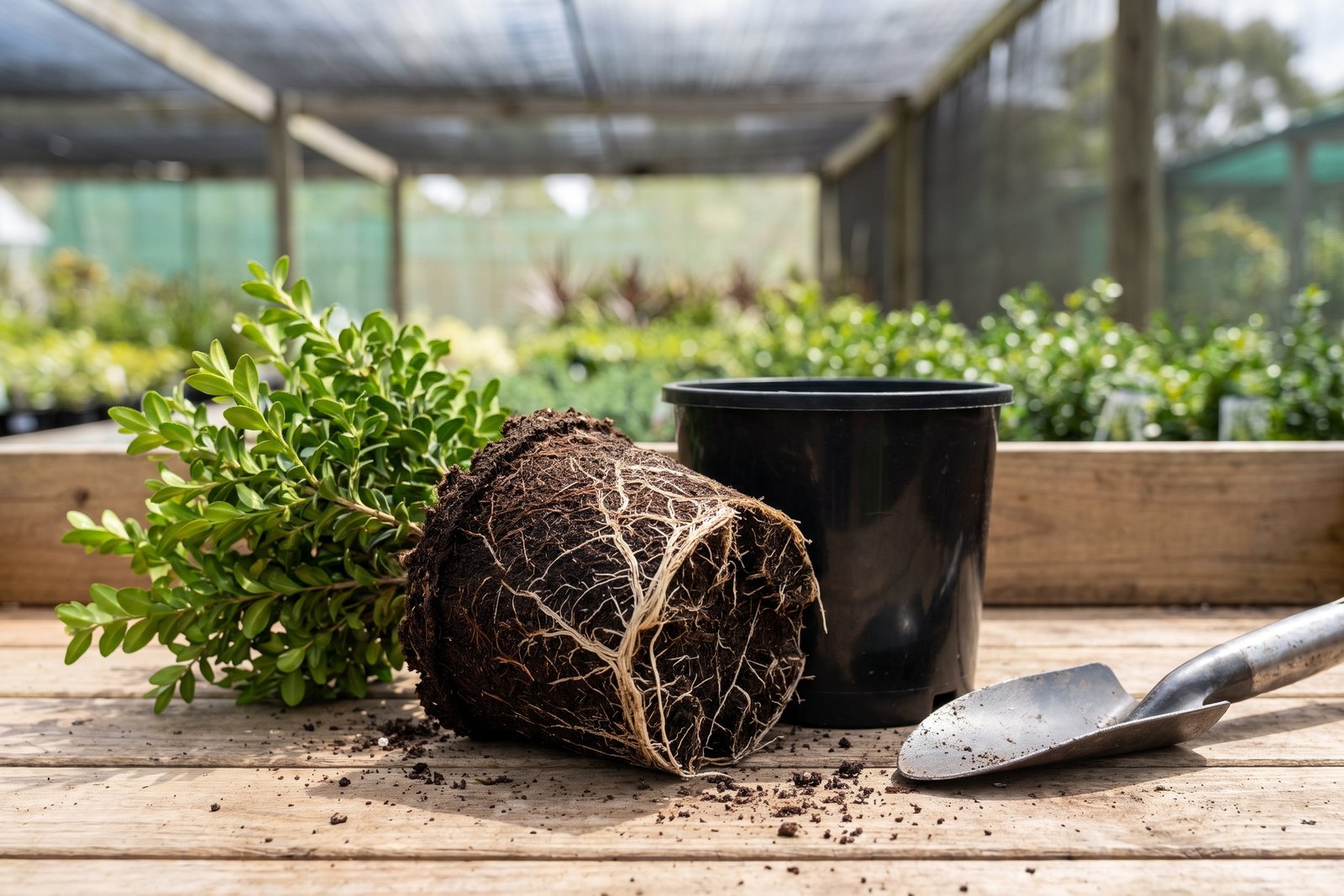
Peat was the trade's standard because it is uniform, light, sterile, acidic and holds both water and air. No single material replaces it, so peat-free media are blends. Each component behaves differently in a pot, and a buyer who knows the differences understands why a peat-free plant may look or water differently from one grown the old way.
| Material | What it is | How it behaves in a pot |
|---|---|---|
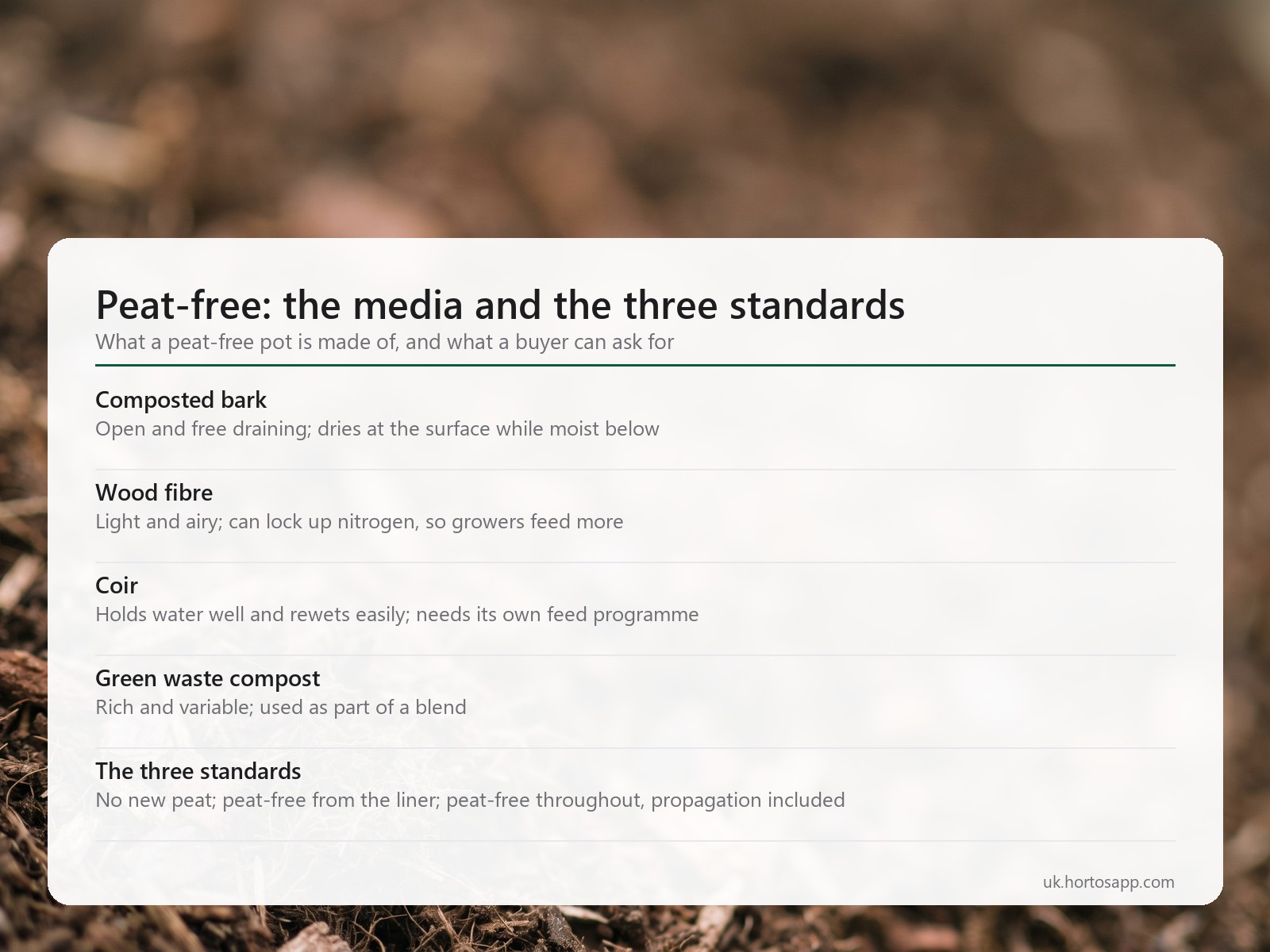
| Composted bark | Conifer bark, composted and graded | Open and free draining; dries at the surface while still moist below |
| Wood fibre | Softwood shredded and heat treated | Light and airy; can lock up nitrogen, so growers feed more |
| Coir | Coconut husk fibre and pith, imported | Holds water well and rewets easily; needs a feed programme of its own |
| Green waste compost | Composted garden and park waste to a national standard | Rich in nutrients and variable; used as a part of a blend |
| Wool and bracken | Sheep's wool and composted bracken, in some British mixes | Holds water and releases nitrogen slowly; a smaller part of the market |
For the buyer, the differences show in three places. A peat-free pot can look dry on top while the root zone is moist, so watering by weight or by a finger pushed into the pot replaces watering by eye. Nutrients leach and lock up differently, so plants from a peat-free nursery may arrive paler or greener than the buyer expects and settle once planted. And a peat-free medium that has dried right out usually rewets more easily than peat, which is a point in its favour on a hot site. None of this changes the planting; it changes the aftercare in the first weeks.
The questions to put to a grower
A nursery that grows peat-free will answer the first question with pride; a buyer who wants to be sure asks all five. From which stage has this batch been grown peat-free, the plug, the liner or only the final pot. What is the medium, and does the nursery buy it under the growing media industry's responsible sourcing scheme. Are the young plants British grown or imported, and if imported, in what. Is the nursery's own propagation peat-free. And will the nursery put the answer on the quote. A grower that cannot answer the first question about a batch does not know, and a grower that will not write the answer down has given one.
The Royal Horticultural Society's phrases do the work in writing. A buyer that wants plants grown without any new peat asks for no new peat; one that will accept an imported plug asks for peat-free from the liner; one that wants the strictest standard asks for peat-free throughout, including propagation. How wholesale plant pricing and availability work in the UK trade explains how such a condition sits on a trade quote.
Writing peat-free into a specification
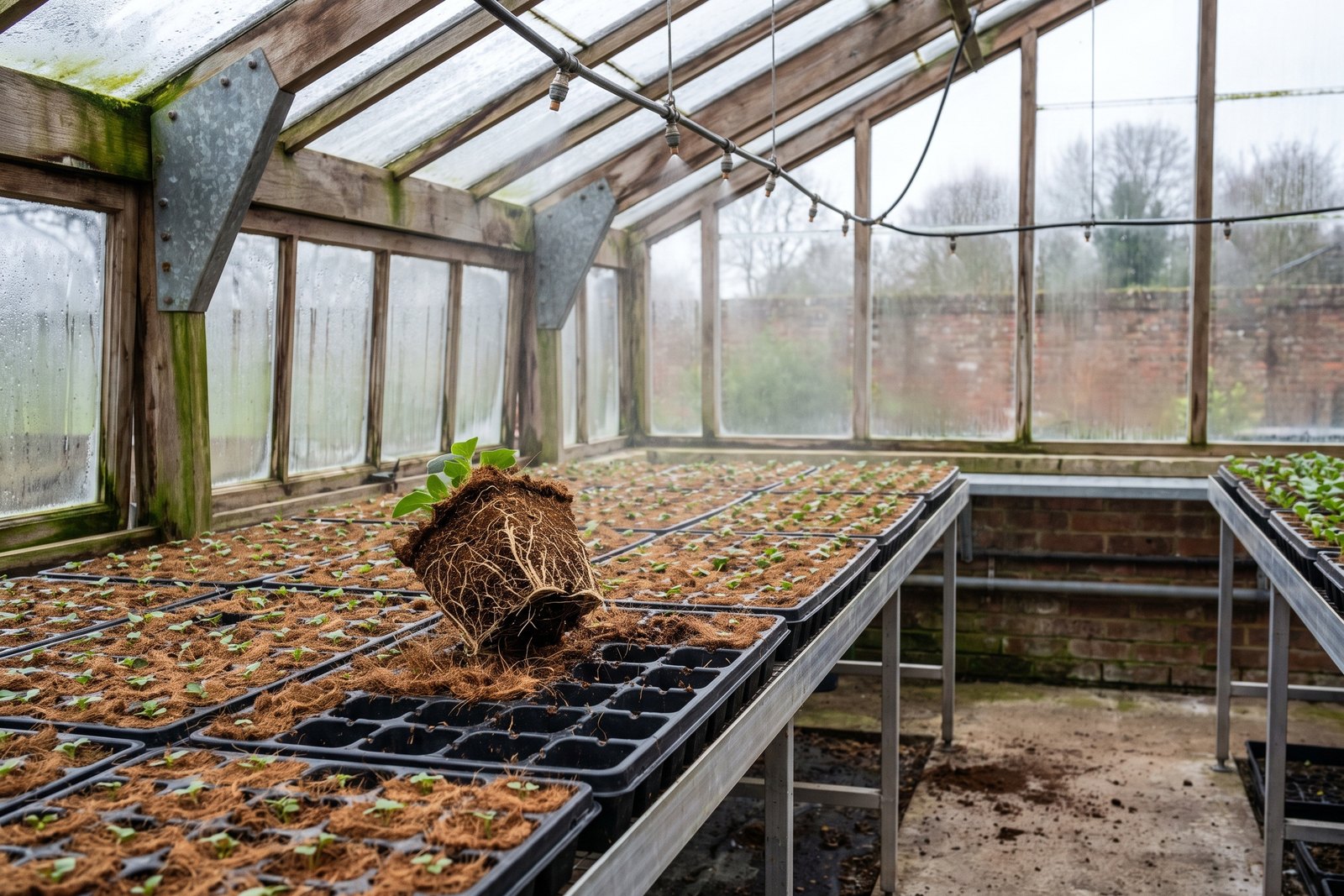
Councils, In Bloom committees, schools and societies increasingly write peat-free into their plant orders, and the wording decides what arrives. A line that says peat-free plants where possible produces whatever the nursery has. A line that names the standard, the stage and the evidence produces peat-free plants or an honest statement that the line cannot be had that way this season. The Society's definitions, a request for the medium to be named, and a request for the grower's confirmation on the delivery note are enough.
Two allowances keep the specification workable. Allow a peat starter plant where a no new peat plant of that species is not grown in Britain this season, and say so, rather than losing the species. And allow the grower to name a substitute species grown to the stricter standard, because a buyer who wants peat-free plants more than a particular cultivar will often get both by asking.
Where the growers are
The growers directory on HortOS lists more than 2,900 growers that sell plants to the trade across the United Kingdom, by county and town, and each grower controls its own listing, prices and delivery. The county pages (Lancashire, Lincolnshire, Cambridgeshire, Staffordshire) show the nurseries near a site. Growers are being added now, and lists and trade prices appear as each grower sends its own. Anyone can read the pages and only the trade can order. A buyer with a peat-free policy writes to the nurseries in the nearest counties, asks the five questions, and orders from the ones that answer them. On 25 October 2026 the county pages listed 199 in Lancashire, 153 in Lincolnshire, 149 in Cambridgeshire, 144 in Staffordshire, 136 in Norfolk and 133 in Cheshire. Buying plants in bulk for a community group in the UK explains how a group places the order.
What to watch for
- Peat-free on the bag and peat in the plug. The compost a plant was potted into says nothing about what it was propagated in.
- Peat-reduced read as peat-free. A reduced medium may still be a third or a half peat; ask for the percentage.
- Dry tops and wet bottoms. Volunteers who water a peat-free pot by eye will overwater it; show them the finger test.
- Pale plants at delivery. A peat-free plant is often lighter in colour on arrival and greens up in the ground; ask the grower rather than rejecting the load.
- Imported plugs under a British label. Ask where the young plant came from, not only where it was grown on.
- A policy nobody wrote down. A council or committee resolution means nothing to a grower unless it reaches the order.
Getting it right
- Decide the standard the group wants, in the Society's words: no new peat, peat-free from the liner, or peat-free throughout.
- Put the standard, the stage and a request for the medium to be named into every request for a quote.
- Ask the five questions of each nursery, and keep the written answers with the order.
- Allow a peat starter plant, or a substitute species, where the strict standard cannot be met this season, and record the decision.
- Brief the planting team on watering peat-free pots by weight and by touch, not by the look of the surface.
- Tell the grower afterwards how the plants did. The nurseries that have made the change are learning from every planting.
A word of caution
The position on peat changes with each announcement, and this page describes it as it stood on the date shown. Where a buyer's decision turns on the law, the government's own pages and the Royal Horticultural Society's are the sources to read on the day. The description of the growing media is general: each nursery's blend is its own, and the grower's advice on watering and feeding its plants replaces anything written here. HortOS does not certify any grower's growing media; a grower's statement about its own production is the grower's, and a buyer that needs assurance asks for it in writing.
Sources
- Royal Horticultural Society, RHS retail peat-free from January 2026: the Society's own switch and definitions.
- Royal Horticultural Society, peat-free gardening: advice on peat-free growing.
- GOV.UK, ending the retail sale of peat in horticulture in England and Wales: the consultation and government response.
- Horticultural Trades Association: the trade's position on the transition.
- Garden Organic: the organic growing charity.
More guides
How Wholesale Plant Pricing and Availability Work in the UK Trade
A trade price is per plant, per size, ex VAT and ex carriage, and the weekly availability list says what can be had now. This page explains how the UK nursery trade is shaped, how a price is built, what the list's columns mean, the size ladder, why prices have moved and how to open an account.
Buying Plants in Bulk for a Community Group in the UK
Garden societies, allotment associations, schools and In Bloom groups can buy plants by the tray, trolley and bundle from British wholesale nurseries when they order like the trade. This page explains what bulk means to a nursery, the three ways a group buys, how a plan becomes quantities, how VAT falls and what happens on delivery day.
Wholesale Plant Growers in Northern Ireland and the Plant Health Rules
In Northern Ireland a plant from Lancashire is an import and a plant from County Louth is not. This page sets out what the HortOS directory lists in the six counties, the plant health position under the Windsor Framework, the label scheme for plants from Great Britain, and what it means for buyers in the province and in the Republic.