Street and Park Trees: What UK Growers Supply and How to Specify Them
A street tree is bought a season before it is planted and judged thirty years after. This page sets out the grades and forms British tree nurseries supply, the standards and guides a specification rests on, how trees are specified and reserved, the duty to consult before felling a street tree in England and where the money has come from.
Updated 29 October 2026. Grower totals from the live uk.hortosapp.com county pages on 29 October 2026; this page quotes no HortOS price figure, because growers are still adding their lists.
On this page
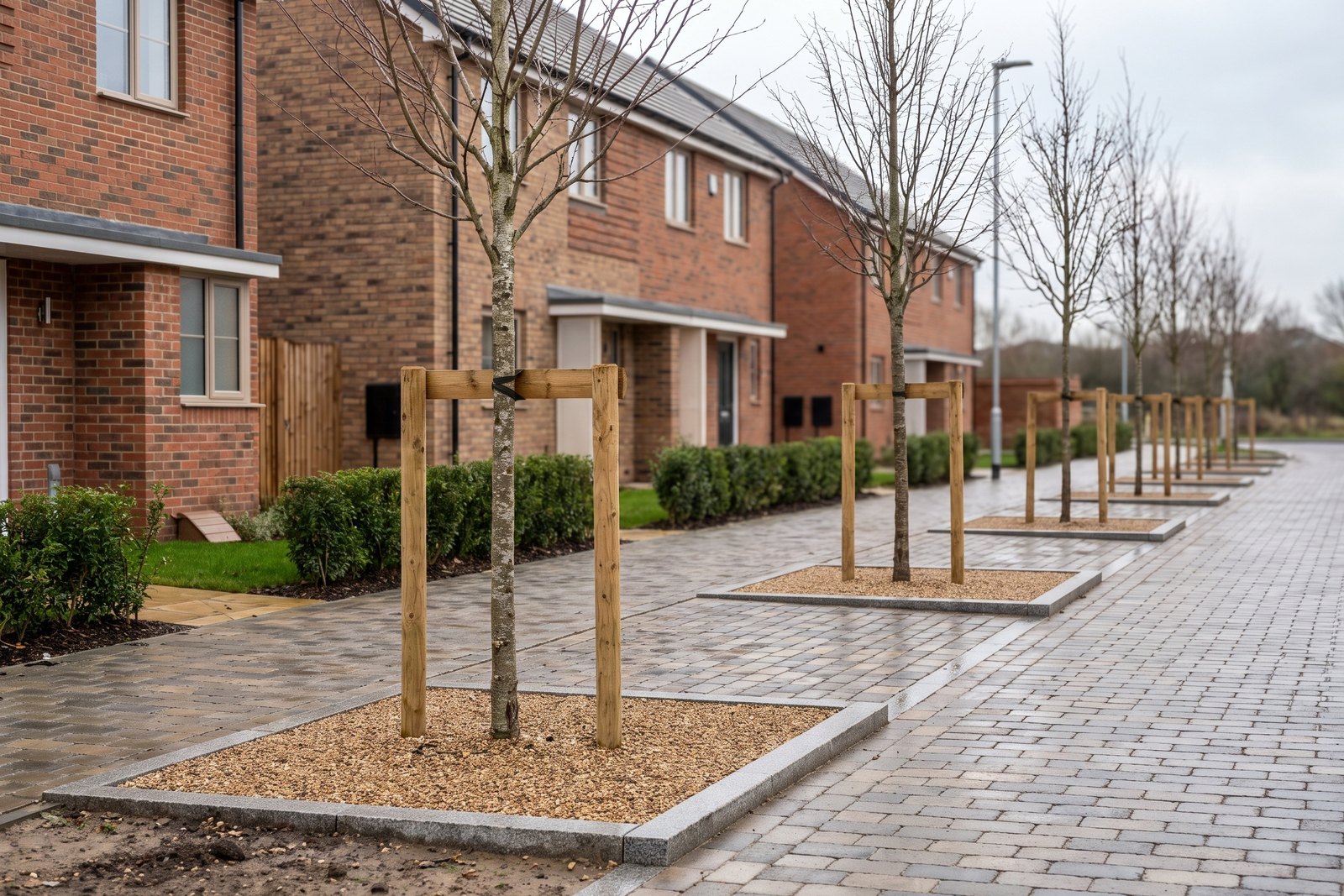
A street tree is bought three years before it is planted and judged thirty years after. The tree nurseries of Britain grow standards in open fields for five to ten years before they are lifted, and the councils, developers and friends groups that plant them choose from what was planted when the order books opened. A specification that names a species, a girth and a form the trade grows, and allows a season to reserve it, gets the tree it asked for. One written in April for a planting in November gets what is left.
This page sets out the forms and grades of tree British growers supply for streets and parks, the standards and guides a specification rests on, how a tree is specified and reserved, the law on felling street trees in England, where the money has come from, and where the tree nurseries are. It draws on HortOS, a free directory of wholesale plant growers in the United Kingdom, listed by county, to which each grower adds its own availability and trade prices, and on what the British Standards Institution, the Trees and Design Action Group, Forest Research and the government publish. It quotes no HortOS price figure, because growers are still adding their lists to the UK site.
Quick facts
| The grades | Trees are graded by the girth of the stem in centimetres at one metre: 8 to 10 for a standard, 10 to 12 and 12 to 14 for selected and heavy standards, 14 to 16 and up for extra heavy standards, and semi-mature above 20. |
|---|---|
| The forms | Bare-root in winter for the smaller grades, rootballed in hessian and wire for most street trees, container grown for planting outside the dormant season, and air pot grown for the biggest. |
| The standard | BS 8545, trees from nursery to independence in the landscape, amended in January 2026 to align it with BS 5837, is the code of practice from nursery to establishment. Nursery stock itself is specified to the national plant specification and BS 3936. |
| The guides | The Trees and Design Action Group's Trees in Hard Landscapes for the pit and the street; Forest Research's Urban Tree Manual for choosing the species for the place. |
| The law | In England a local highway authority must consult the public before felling a street tree, with exceptions for small, dead and dangerous trees, under section 115 of the Environment Act 2021. |
| Lead time | A season. Reserve in spring or summer for a winter planting; contract grow for a scheme that needs numbers of one species in one grade. |
The forms and grades growers supply
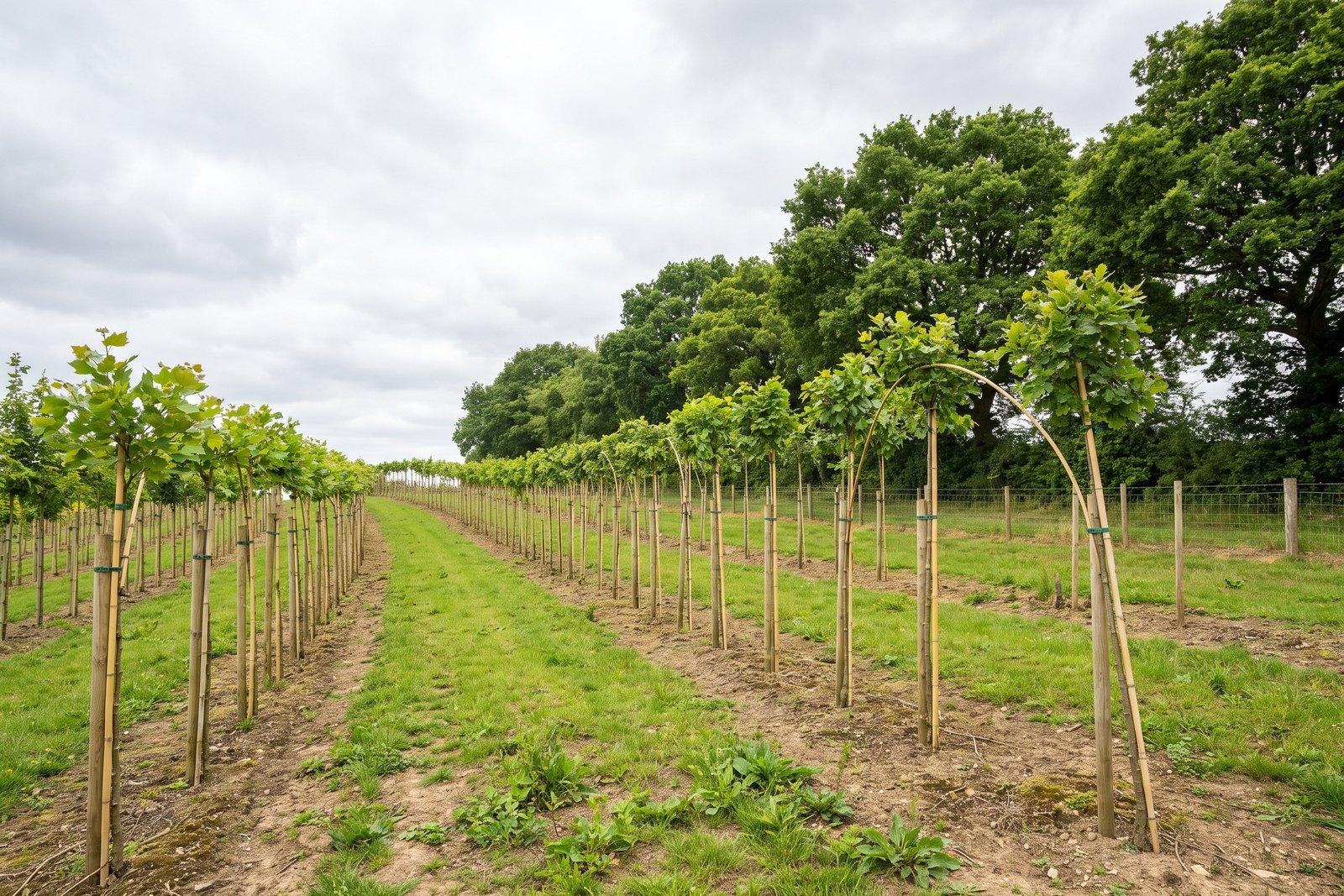
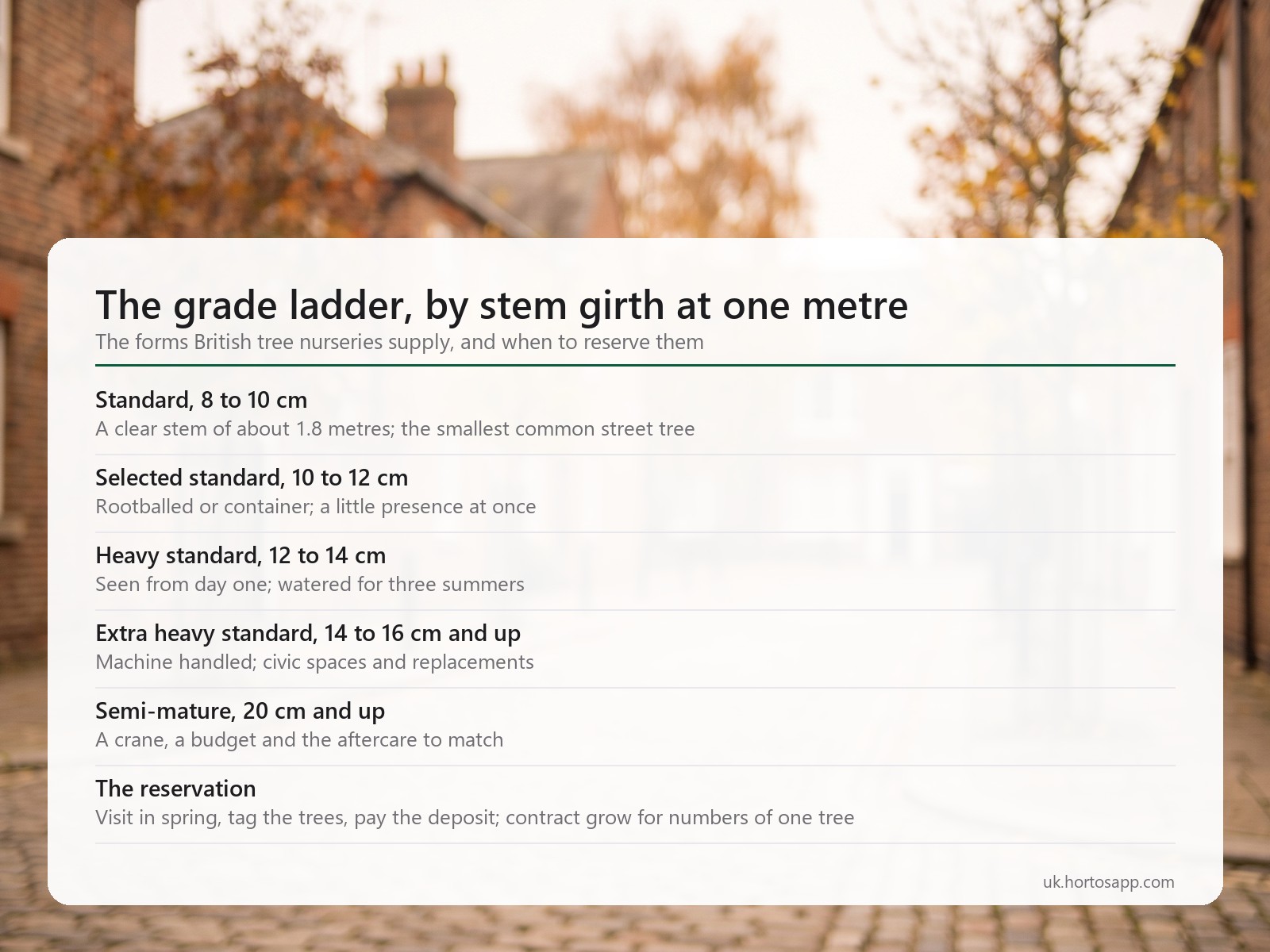
The trade grades a tree by the circumference of its stem, measured one metre from the ground, in two centimetre bands. An 8 to 10 centimetre standard has a clear stem of about 1.8 metres and a crown above it, and is the smallest tree most councils will plant in a street. A 12 to 14 heavy standard is the common choice where a tree must be seen from the day it is planted and will be watered. Above 16 to 18 the trees are extra heavy standards and then semi-mature, lifted with a large rootball by machine and priced on application. The grades below a standard, whips and feathered trees, are sold by height and used in parks, woodlands and screens rather than streets.
| Grade | Stem girth at 1 m | Form and handling | Where it is used |
|---|---|---|---|
| Feathered, 175/200 to 250/300 | Sold by height | Bare-root or rootballed; branches to the ground | Parks, woodland edges, screens, trees to be trained |
| Standard | 8 to 10 cm | Bare-root or rootballed; clear stem about 1.8 m | Residential streets, parks, schools; the smallest street tree |
| Selected standard | 10 to 12 cm | Rootballed or container | Streets and squares where a little presence is wanted at once |
| Heavy standard | 12 to 14 cm | Rootballed, container or air pot | Town centres, avenues, new developments; needs watering for three years |
| Extra heavy standard | 14 to 16 cm and up | Rootballed or air pot; machine handled | Civic spaces and replacement of a lost mature tree |
| Semi-mature | 20 cm and up | Large rootball or container; crane or machine | Instant effect where the budget and the aftercare exist |
Rootballed trees are lifted from the field in the dormant season, October to March, with a ball of soil held in hessian and a wire basket, and planted as they are. Container and air pot grown trees can be planted at other times, at a higher price and with the same need for water. Bare-root standards are the cheapest and move only in winter. Bare-root season in the UK explains that window.
The standards and guides a specification rests on
Three documents carry most of the weight. BS 8545, trees from nursery to independence in the landscape, is the British Standards Institution's code of practice for the whole journey of a young tree, from nursery production through despatch, transport, storage, planting and the years of aftercare until the tree can look after itself. It was amended in January 2026 to align it with BS 5837, trees in relation to design, demolition and construction, and the amended edition supersedes the 2014 one. The nursery stock itself, the girth bands, the clear stem, the number of breaks and the rootball size for each grade, is specified against the national plant specification that the trade and its customers have used for thirty years and the older BS 3936 series.
Beside the standards sit two guides that most tree officers keep to hand. The Trees and Design Action Group's Trees in Hard Landscapes explains how to give a street tree the rooting volume, the water and the protection it needs under paving, and why so many street trees fail without them. Forest Research's Urban Tree Manual sets out how to choose the right species for a place, with climate, pests and the size of the site in mind, and its lists are the ones most councils' species palettes are drawn from.
Specifying and reserving the trees
A tree specification names the species and cultivar, the grade, the form, the root condition, the number of times transplanted, the minimum rootball or container size, the clear stem height and the quality the tree must meet on delivery: a single leader, a balanced crown, no damage, no pests, a plant passport. It names the standard the trees are to be grown and handled to. And it says when the trees are wanted, where they will be delivered, how they will be unloaded, and who will water them for how long.
The reservation is the part most often missed. A nursery lifts to order, and the popular street trees in the popular grades are reserved by summer for the winter. A council that visits the nursery in spring, tags the trees it wants and pays a deposit gets the trees it saw. A scheme that needs a hundred of one cultivar in one grade for one street asks the nursery to contract grow them, two or three years ahead, at a price agreed now. Species diversity is written into the specification too; the common rule of thumb that no one species should be more than a tenth of a town's trees, no genus more than a fifth and no family more than three tenths, is the reason a nursery is asked for twelve species rather than two. How wholesale plant pricing and availability work in the UK trade explains the terms on a tree nursery's list.
Biosecurity for trees
Trees carry the trade's worst pests, and buyers specify against them. Every tree for planting that moves between businesses in Great Britain carries a UK plant passport. Oak for planting in England is subject to the oak processionary moth rules, which restrict where oaks may be grown and moved around the management zones in London and the South East. Many councils now specify trees grown in Britain for at least a full season before delivery, or held in quarantine on arrival, and prefer nurseries with Plant Healthy certification. Plant passports and plant health rules for plant buyers sets the rules out.
The law on felling, and where the money has come from
Since the Environment Act 2021 a local highway authority in England must consult the public before felling a street tree, meaning a tree on an urban road other than a trunk or classified road, with exceptions for a tree whose stem is no more than eight centimetres across at 1.3 metres, a tree the authority considers dead or dangerous, and felling required by other law or by authorised development. The duty changed how councils plan replacements, because a felled tree is now a public matter and a planted one is the answer to it. Scotland, Wales and Northern Ireland have no equivalent duty in the same terms.
The money for new street and park trees in England came for several years from two Forestry Commission funds, the Urban Tree Challenge Fund for standards in towns and the Local Authority Treescapes Fund for trees outside woodland. Both are closed to new applications, the government withdrew their guidance in March 2025, and the planting and maintenance they paid for runs on into 2026 and 2027. Councils and groups now look to the Forestry Commission's current grant list, to developer contributions, to their own capital programmes and to the national charities, Trees for Cities among them, that plant with communities. Buying plants in bulk for a community group in the UK explains how a friends group turns a grant into an order.
Where the tree nurseries are
The growers directory on HortOS lists more than 2,900 growers that sell plants to the trade across the United Kingdom, by county and town, and each grower controls its own listing, prices and delivery. The county pages (Lancashire, Lincolnshire, Cambridgeshire, Staffordshire) show the nurseries near a site. Growers are being added now, and lists and trade prices appear as each grower sends its own. Anyone can read the pages and only the trade can order. The field tree nurseries are concentrated in the Midlands, the North West, Yorkshire and East Anglia, and a tree officer or a friends group visits them in spring. On 29 October 2026 the county pages listed 199 in Lancashire, 153 in Lincolnshire, 149 in Cambridgeshire, 144 in Staffordshire, 136 in Norfolk and 133 in Cheshire.
What to watch for
- A grade without a form. A 12 to 14 bare-root tree and a 12 to 14 air pot tree are different purchases with different planting windows.
- Species chosen from last year's list. Ask for the current availability before the palette is fixed.
- A tree pit designed after the tree is bought. Read Trees in Hard Landscapes first; the pit decides the tree's life.
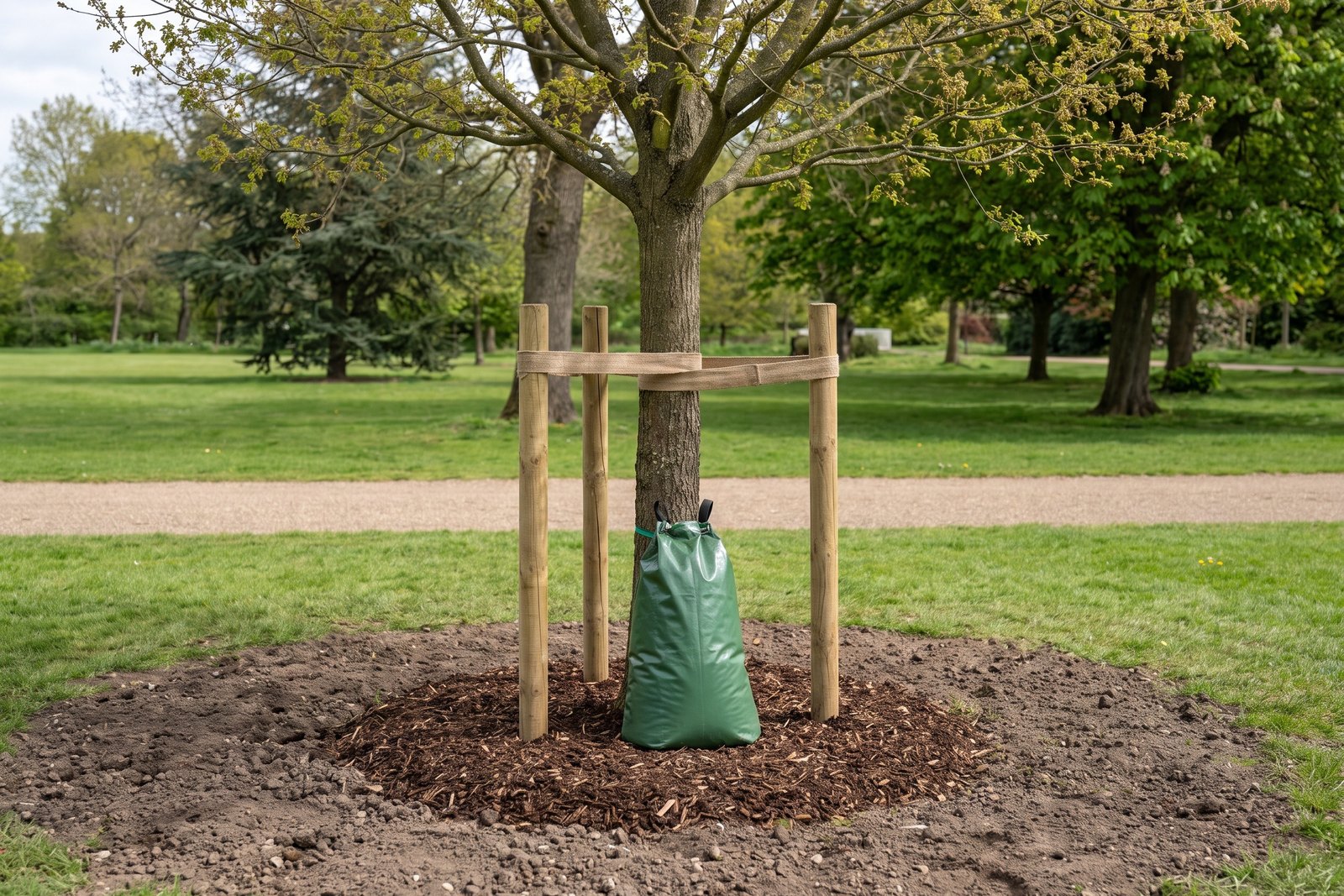
- No watering budget. A heavy standard needs water for three summers, and the Urban Tree Manual's advice is wasted without it.
- Oak specified for the South East without asking about the moth zones.
- A fund assumed open. Check the Forestry Commission's current list; the two funds most groups remember are closed.
Getting it right
- Choose species for the place from the Urban Tree Manual's lists and the council's own palette, with diversity written in.
- Specify grade, form, root condition, clear stem, quality on delivery and the standard the trees are grown and handled to.
- Visit the nursery in spring, tag the trees, pay the deposit, and contract grow where a scheme needs numbers of one tree.
- Design the pit and the watering before the trees are ordered.
- Take delivery in the dormant season, check each tree against the specification, and plant within days.
- Water, mulch, check ties and stakes for three years, and record the trees in the council's inventory.
A word of caution
The grades and forms on this page are the trade's common usage and the standards are described in outline; the British Standards Institution's documents, the national plant specification and the guides named are the texts a specification cites, and a council's own tree strategy and procurement rules take precedence over anything summarised here. The law is described for England as it stood on the date shown. Funding changes from year to year, and the Forestry Commission's pages are the place to check what is open. HortOS lists growers and does not grade, inspect or certify trees; the nursery's quotation and the specification between buyer and grower govern every order.
Sources
- British Standards Institution, BS 8545:2014+A1:2026, trees from nursery to independence in the landscape: the code of practice for young trees.
- Trees and Design Action Group: the urban tree knowledge network.
- Trees and Design Action Group, Trees in Hard Landscapes: a guide for delivery: designing tree pits that work.
- Forest Research, Urban Tree Manual: choosing the right tree for the place.
- Environment Act 2021, section 115, duty to consult before felling street trees: the consultation duty in England.
- GOV.UK, Urban Tree Challenge Fund: a closed fund, kept for its record.
- GOV.UK, Local Authority Treescapes Fund: a closed fund, kept for its record.
- Arboricultural Association: the arborists' professional body.
More guides
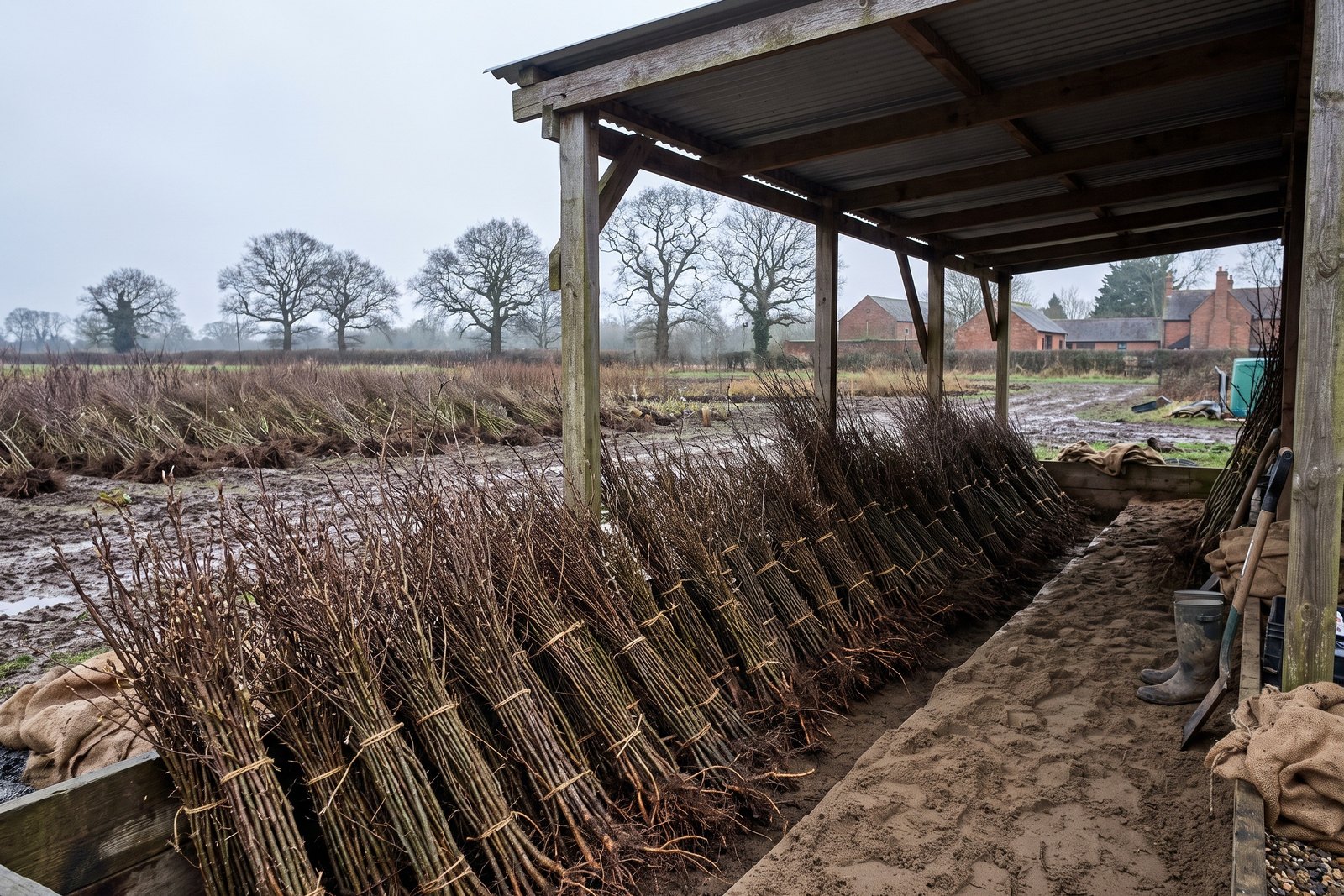
Bare-Root Season in the UK: What Growers List and When
From November to March British nurseries lift deciduous trees, hedging, roses and fruit from open ground and sell them bare-root at a fraction of the container price. This page explains what is sold this way, the height, girth and transplant codes on a list, how the season runs and how the plants are handled.
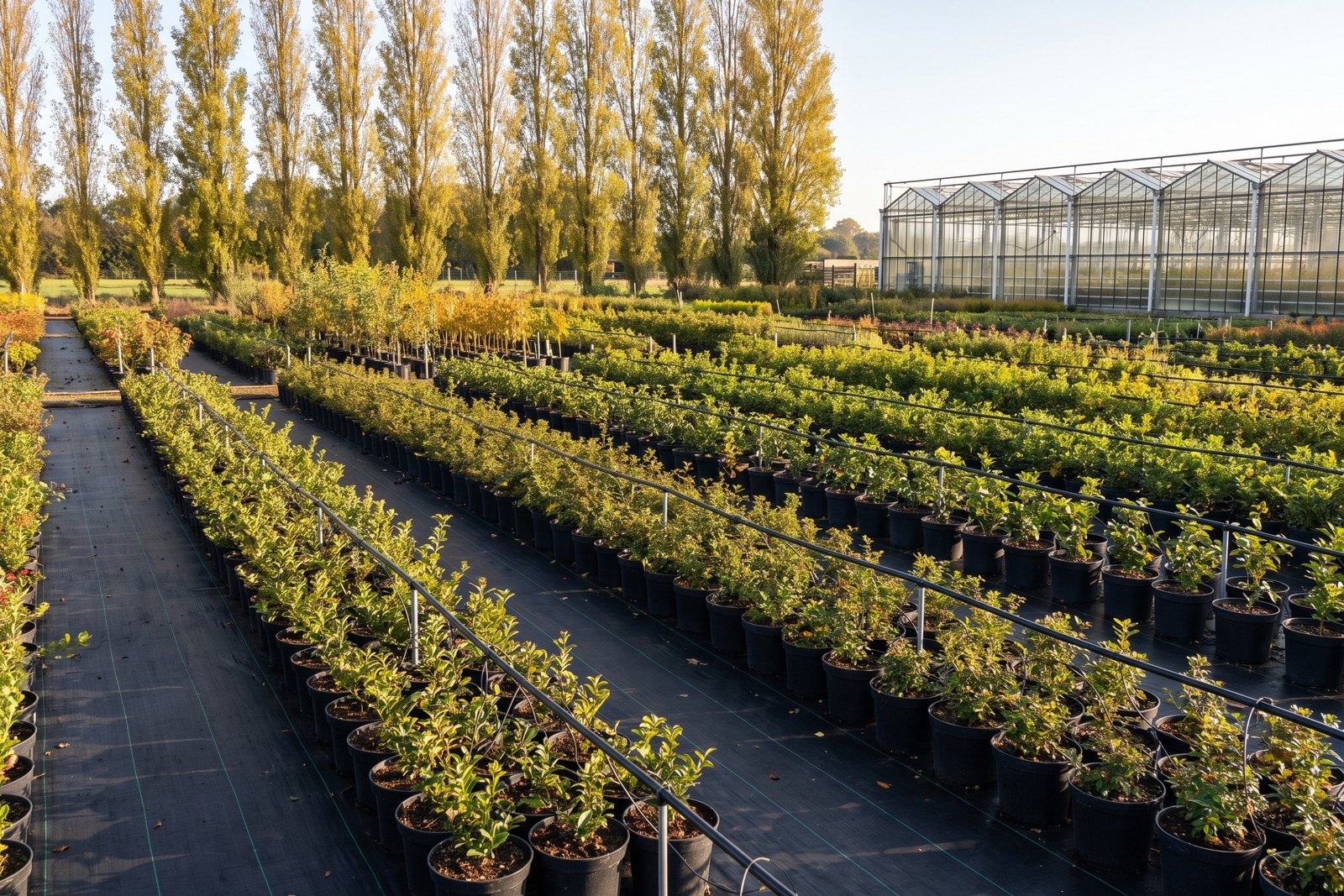
How Wholesale Plant Pricing and Availability Work in the UK Trade
A trade price is per plant, per size, ex VAT and ex carriage, and the weekly availability list says what can be had now. This page explains how the UK nursery trade is shaped, how a price is built, what the list's columns mean, the size ladder, why prices have moved and how to open an account.
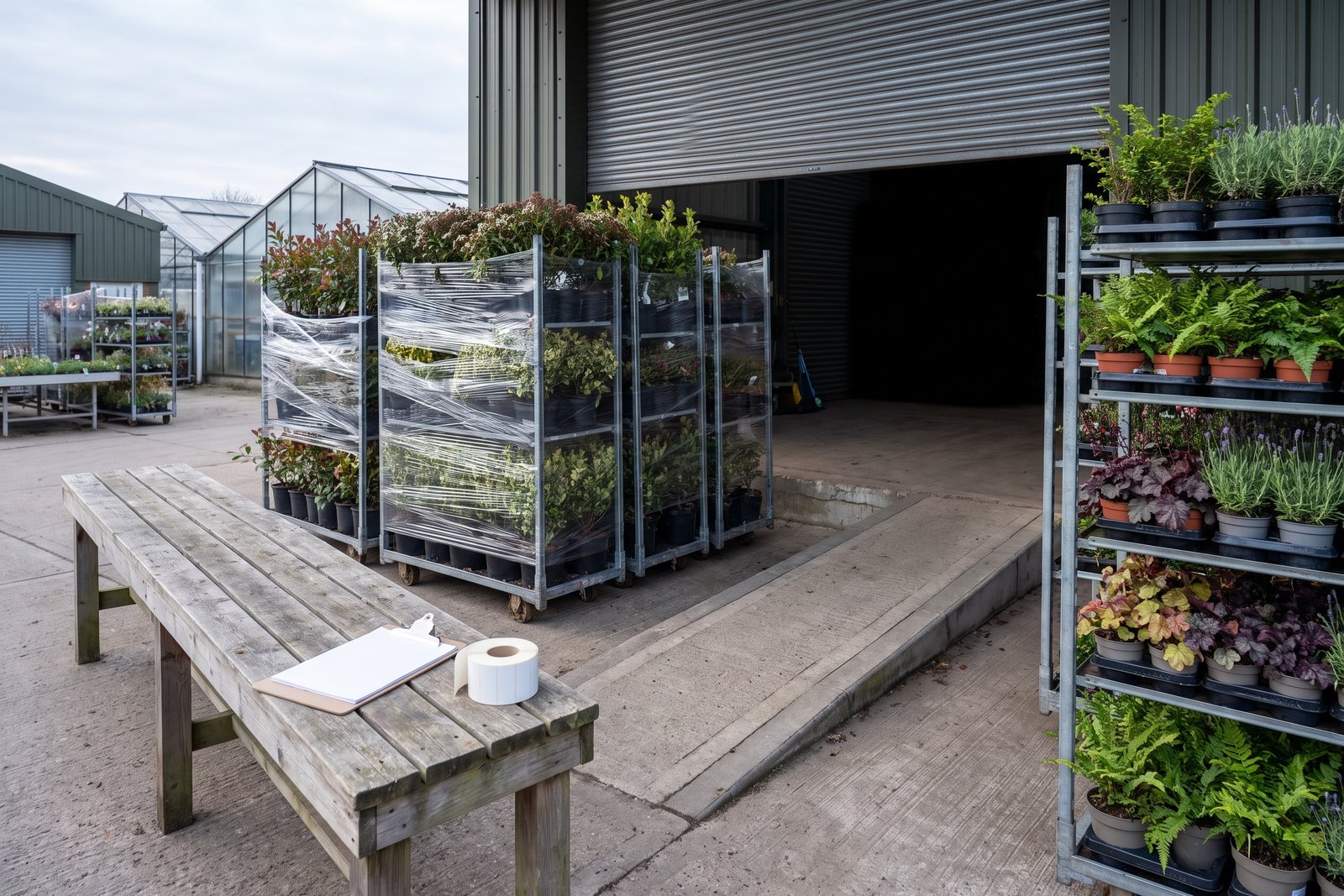
Plant Passports and Plant Health Rules for Plant Buyers in the UK
Every consignment of plants that moves between businesses in Great Britain carries a UK plant passport, and a buyer sits at the end of that chain. This page explains what the passport is and who issues it, what a buyer should expect and keep, how imported plants are checked, the rules on oak, the Northern Ireland position and Plant Healthy.